A Koseiteki Deep Dive · Telecoms and Telecom-Adjacent Sectors
Years of Safaricom Dominance, the Mobile Money Moat, the Eligible Challengers and the Chances They Stand
Source: Communications Authority of Kenya, June 2026.
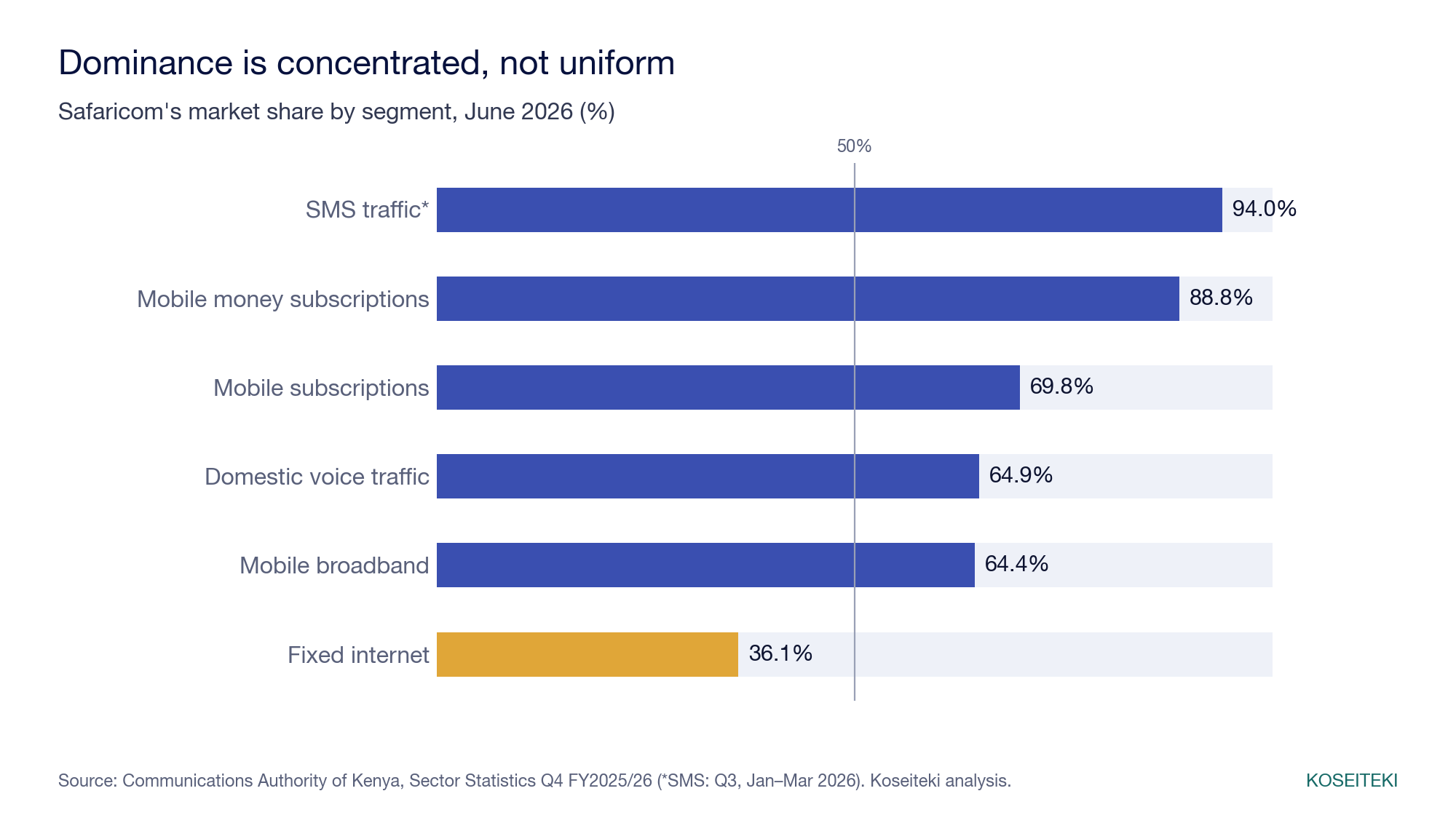
Then and now: the stories behind the numbers, from a three-horse race to a Safaricom-dictated market
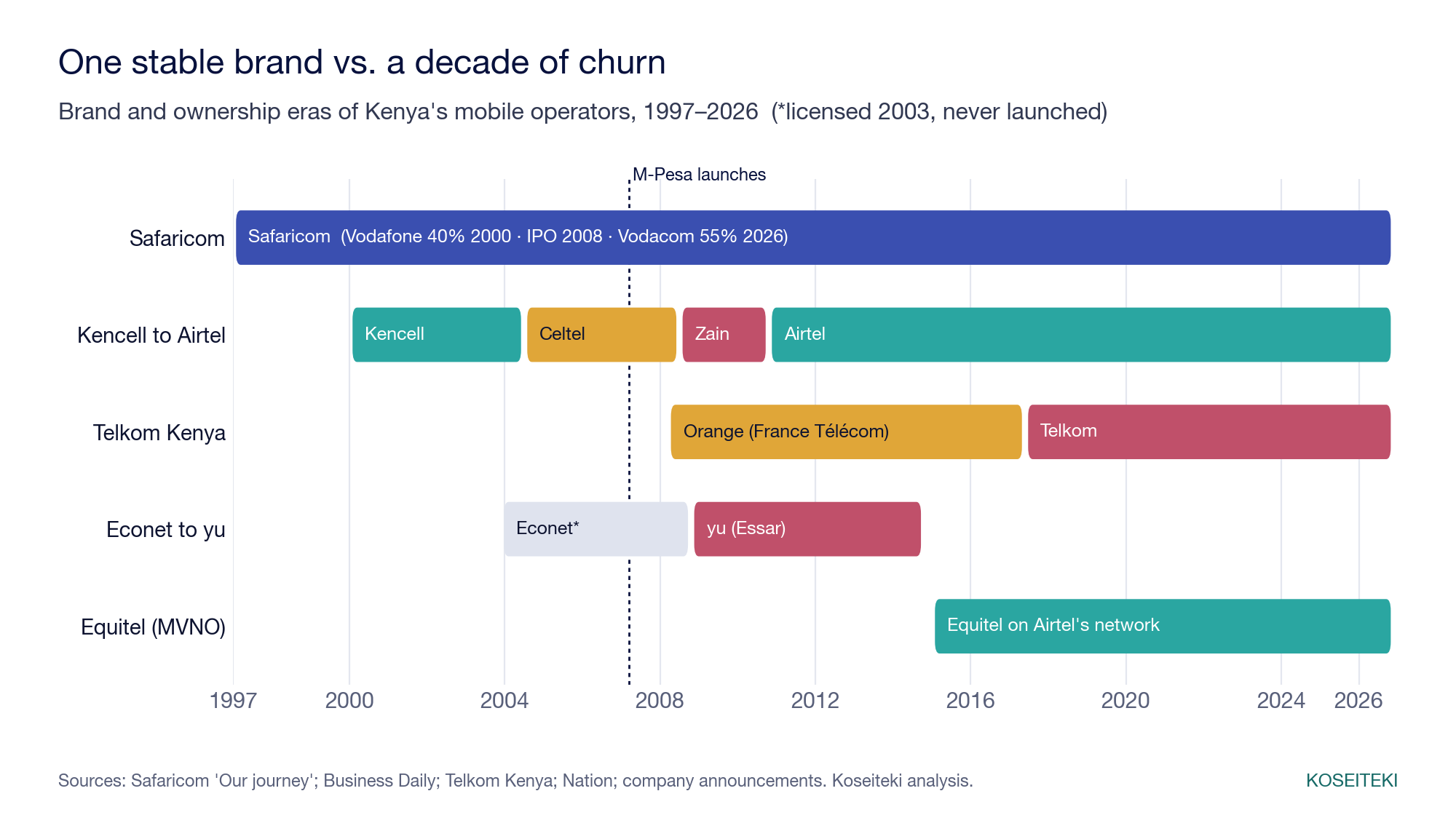
In 2000, Kenya’s mobile sector was liberalised, ending Telkom Kenya’s monopoly. Safaricom was founded in 1997 as a fully owned subsidiary of Telkom Kenya before the UK’s Vodafone Group acquired a 40% stake, along with management responsibility, in May 2000. It has since evolved from a mere mobile service provider into a technology company. Kencell, a joint venture between France’s Vivendi (60%) and local investor Naushad Merali’s Sameer Group (40%), won the second GSM licence in 2000, creating Kenya’s first real duopoly. Econet Wireless won the third GSM licence with a US$27 million bid in 2003, after a long legal and political battle, but never launched: its local partner failed to raise its share of the fee, and the company eventually passed to India’s Essar, which launched yu in November 2008. By then the market had already hardened around two dominant players.
Kencell has an instructive corporate history. It rebranded to Celtel in 2004, after Merali brokered the sale of Vivendi’s 60% stake to Mo Ibrahim’s Celtel. Celtel was bought by Kuwait’s MTC (later renamed Zain) from 2005, and the Kenyan unit took the Zain name in 2008. Bharti Airtel then acquired it in June 2010 and rebranded it a third time, to Airtel. That is three ownership changes and three brand changes in a decade, a level of instability Safaricom never experienced. Telkom Kenya, meanwhile, entered mobile relatively late. France Télécom bought 51% at the end of 2007 and launched the Orange Kenya network in 2008. After Helios Investment Partners bought France Télécom’s stake in 2016, the business reverted to the Telkom name in 2017, and the government took back full ownership in 2022. That is a multi-decade identity crisis of its own.
The result: while Safaricom built a single, stable brand and a first-mover advantage in mobile money from 2007 onward, its two principal rivals spent the same fifteen years being bought, sold and rebranded. By the time Airtel Kenya settled into a stable identity and ownership structure in the 2010s, Safaricom had already built a moat that few realised was being built at the time: M-Pesa.

2026: the owner changes too
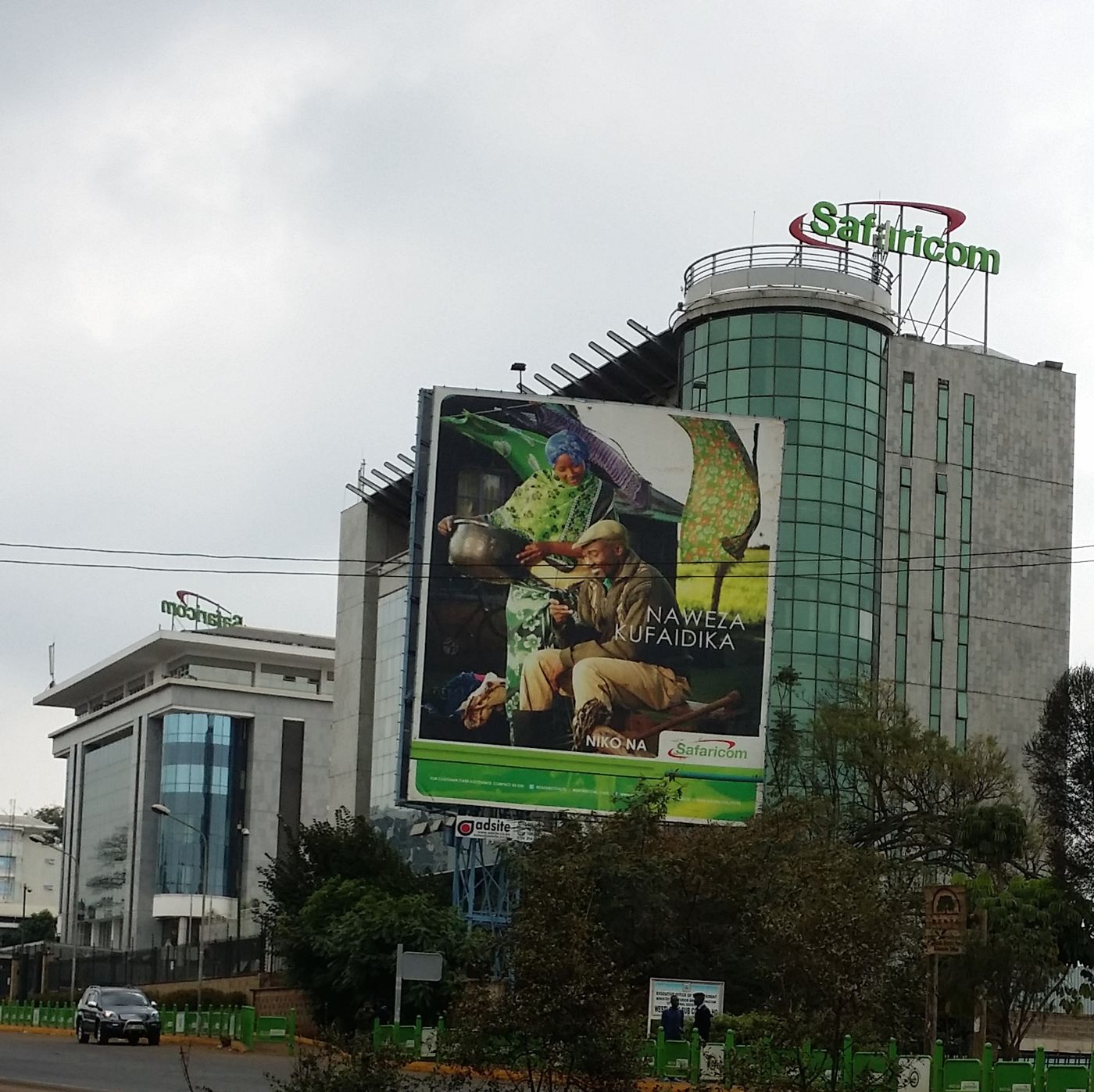
The one constant in this story, Safaricom’s stable shareholder base, has itself become contested. In December 2025 the Kenyan government agreed to sell 15% of Safaricom to Vodacom, with Vodafone selling it a further 5%. Vodacom completed the purchase in June 2026, taking its stake to 55% and majority control. The government’s holding fell to 20%, and the public float stayed at 25%. On 15 September 2026, a three-judge High Court bench declared the government’s sale unconstitutional, citing a lack of meaningful public participation and the concealment of material information. It ordered the 15% returned to the State. Both Vodacom and the government have said they will appeal.
The numbers then and now
| Metric | ~2006–2010 | 2026 |
|---|---|---|
| Mobile operators | 3–4 (Safaricom, Celtel/Zain, Orange/Telkom; Essar's yu from 2008) | 4 licensed MNOs (Safaricom, Airtel, Telkom, JTL) + MVNO (Equitel) + satellite (Starlink) |
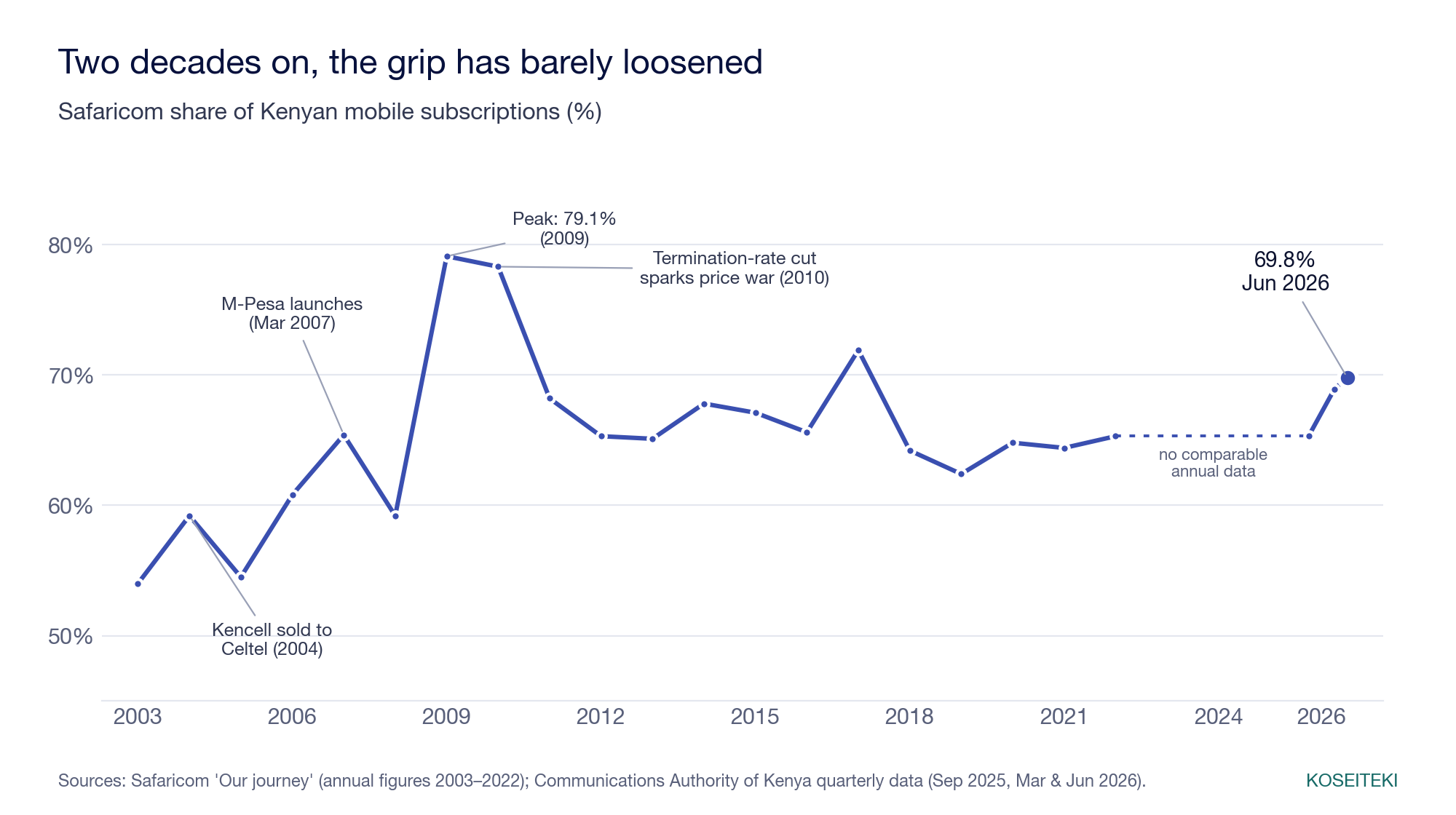
| Safaricom market share | 60.8% (2006), 65.4% (2007); peaked at 79.1% in 2009 | 69.8% of subscriptions (June 2026), rising |
| Total mobile subscriptions | ~10–16 million (2007–2008; teledensity still low) | 88.0 million (June 2026); penetration 165% |
| Mobile money | M-Pesa launched March 2007; ~1.2 million registered customers by end-2007 | 46.4 billion M-Pesa transactions a year; KSh 41.68 trillion moved (FY2026) |
| Fixed/broadband internet | Negligible; dial-up and early ADSL era | 2.84 million fixed connections, fibre-led |
| Safaricom annual revenue | KSh 47.4 billion (FY2007) to KSh 61.4 billion (FY2008) | KSh 414.1 billion group service revenue (FY2026) |
| Safaricom ownership | Government 60% / Vodafone 40%; IPO in 2008 took the State to 35% | Vodacom 55% / Government 20% / public 25% (sale voided by the High Court, under appeal) |
The new entrant’s effect
Depending on the layer of the stack, “new entrant” means different things in Kenya’s telecom space. No newly launched national voice/data mobile network operator (MNO) has broken into Kenya’s mainstream retail mobile market since Airtel (as Zain) in the 2000s. Essar Telecom Kenya (yu) entered in 2008 and exited in 2014, barely six years later, with its customers and assets split between Airtel and Safaricom. Equitel, launched in 2015 by Equity Bank subsidiary Finserve as an MVNO riding on Airtel’s network, is the most credible new mobile entrant of the last decade. But it has stalled at roughly 1.7% market share (1.47 million subscriptions in June 2026): useful for Equity’s banking ecosystem, never a serious independent threat. The closest thing to a genuine new MNO is Jamii Telecommunications Limited (JTL), a dominant local home-fibre provider. Unlike Safaricom and Airtel, JTL skipped traditional 2G and 3G voice towers and built a lean, data-only 4G network. Because it has no legacy voice network, calls on Faiba work only on phones that support Voice over LTE (VoLTE). Even so, JTL’s mobile base reached 937,640 subscriptions (1.1%) by June 2026, overtaking Telkom Kenya. It remains a niche data play rather than a mainstream SIM alternative for everyday Kenyans.
The more consequential “new entrants” have come at the infrastructure and internet-service layer, not the mobile voice layer: Wananchi Group (Zuku), Poa Internet, Ahadi Wireless (Konnect), Vilcom Network, Mawingu Networks and, as a licensed but tiny player, Starlink. These operators compete almost entirely in fixed and fixed-wireless broadband, a market Safaricom does not dominate the way it dominates mobile voice and money.
Jamii Telecommunications’ Faiba: the closest thing to a real challenger
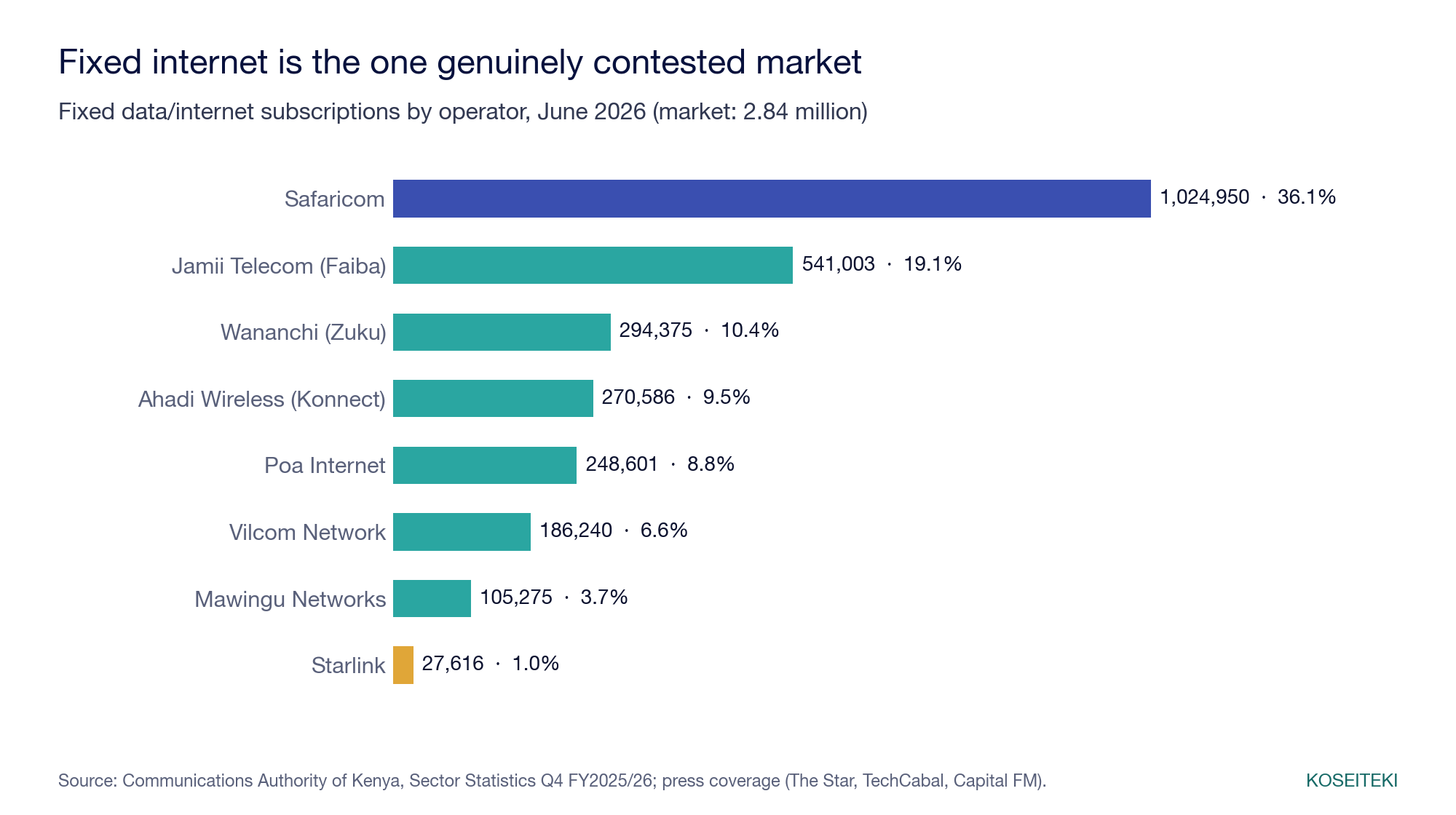
Jamii Telecommunications Limited (JTL), operating under the Faiba brand, is Kenya’s clearest example of a genuine new entrant reshaping a segment of the telecom space. JTL built a fibre-to-the-home (FTTH) network from the ground up rather than inheriting legacy copper infrastructure, and has held the number-two position in Kenya’s fixed internet market for several years running. According to the CA sector report for the period ending June 2026, JTL Faiba has 541,003 active fixed connections, trailing only Safaricom (1.02 million). That is a 19.1% share of the national fixed broadband market, down from 20.1% in December 2025 as Safaricom’s fixed base grows faster in absolute numbers. JTL’s subscriber count is still growing, with 23,733 net additions in the first half of 2026.
Zuku under new ownership: consolidation has already begun
The third-largest fixed operator changed hands in November 2025, when Axian Telecom’s Yas completed the acquisition of 99.63% of Wananchi Group, owner of Zuku (consumer broadband and pay-TV) and Simbanet (enterprise) across Kenya, Tanzania, Uganda and Malawi. Axian did not disclose a price; Kenyan press reported the deal at around KSh 9.6 billion. Wananchi has been folded into a new unit, Axian Telecom Fibre, with an explicit mandate to scale FTTH, SD-WAN and cloud connectivity. Axian already serves more than 41 million customers across 11 markets. In June 2026, Zuku held 294,375 fixed subscriptions (10.4%).
The effect, at a glance
- Retail pricing in fixed broadband has fallen meaningfully faster than in mobile voice and data, directly attributable to JTL, Poa and the smaller ISPs forcing Safaricom to compete on price in a segment it doesn’t structurally dominate.
- No new entrant has meaningfully dented Safaricom’s mobile voice, SMS or (until Airtel Money’s recent run) mobile money position. Those segments remain close to winner-take-all.
- The MNO layer itself has been essentially closed to new entry for over a decade. All genuine competitive dynamism in the last five years has come from the ISP/fixed layer and from Airtel’s fintech pivot, not from anyone building a new mobile network from scratch.
The mobile money war: can M-Pesa actually be dethroned?
Safaricom released its FY2026 results on 7 May 2026, and the M-Pesa statistics lead to some interesting conclusions. The platform processed 46.4 billion transactions in the year, moving a total of KSh 41.68 trillion, more than twice Kenya’s annual nominal GDP. M-Pesa revenue reached KSh 182.7 billion, up 13.4% year-on-year. It now accounts for 45.6% of Safaricom’s Kenya service revenue (44.1% of group service revenue), the single largest line item in the company by a wide margin. One-month active M-Pesa customers rose 14.5% to 40.99 million, and M-Pesa alone contributed 59.2% of Safaricom’s total incremental revenue growth for the year. This is not a side business; it is the business.
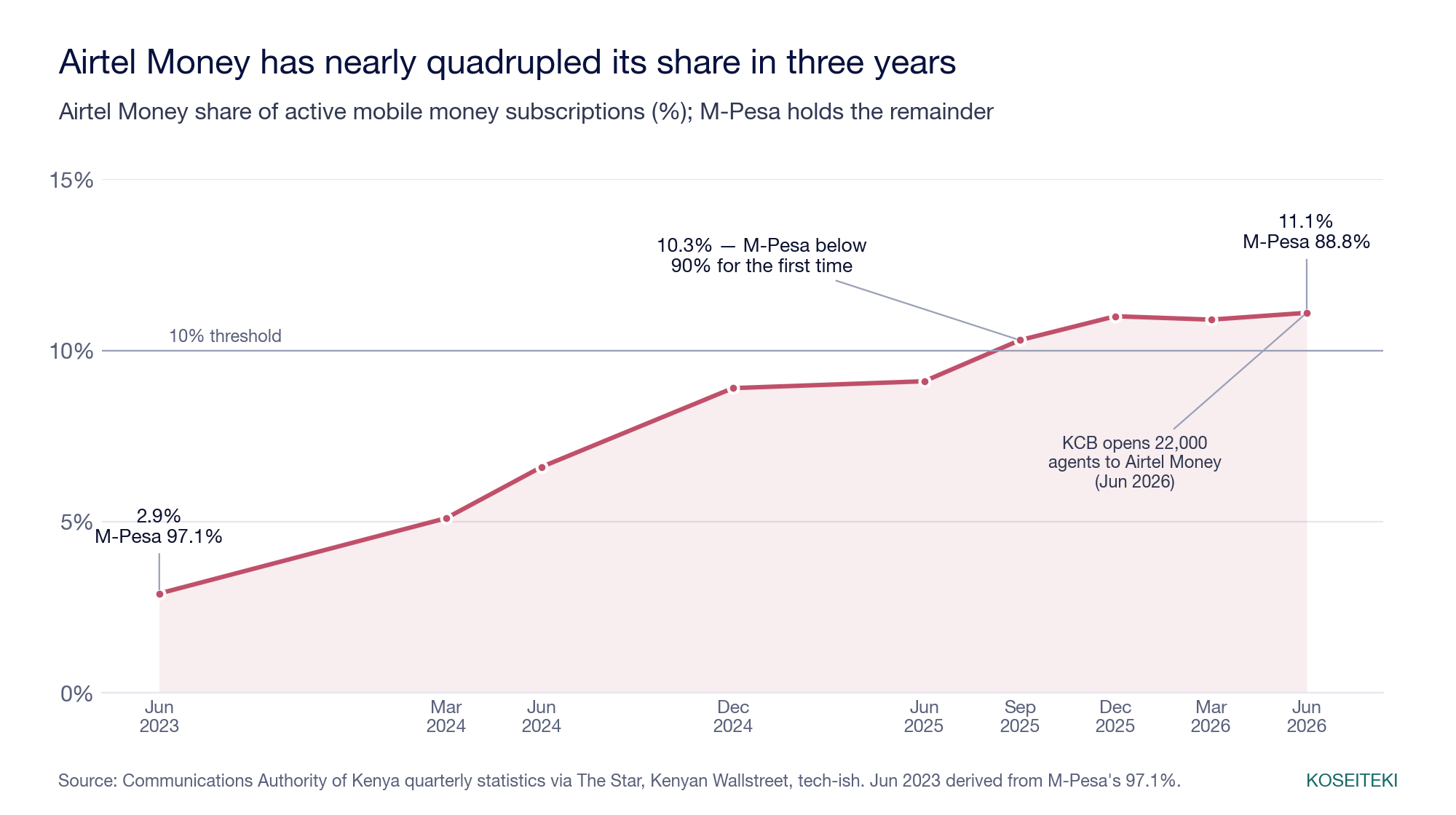
Against that backdrop, Airtel Money’s rise is real, if still small in absolute terms. Airtel Money’s share of mobile money subscriptions climbed from roughly 5.1% in March 2024 to 8.9% by December 2024, 10.3% by September 2025, 11.0% by December 2025 and a record 11.1% by June 2026. That is a sustained, multi-year trend, not a single quarter’s blip. Correspondingly, M-Pesa’s share has slipped from about 97% in mid-2023 to 88.8% in June 2026. It first fell below 90% in September 2025, the first time in the platform’s history. The market is still growing (54.0 million active subscriptions, up 13.2% in a year), so M-Pesa’s falling share reflects Airtel growing faster, not M-Pesa shrinking.
T-Kash, Telkom Kenya’s mobile money product, has effectively rounded to zero market share since late 2023. Telkom’s underlying subscriber base has been in freefall: the operator lost 160,464 subscribers in the January–March 2026 quarter alone, closing at 584,438, and fell further to 545,765 (0.6% of the mobile market) by June. A mobile money product cannot survive on a shrinking host network with under 1% share. T-Kash today is a rounding error, not a genuine competitor, whatever its historical ambitions.
How Airtel actually did it
Airtel Money’s gains are not accidental. Three specific, documented moves explain most of the shift:
- Lower fees and aggressive pricing, particularly on cross-network transfers. For years Airtel’s cross-network sending fees undercut M-Pesa’s, though the two have since converged onto matched fee bands as of mid-2026.
- Agent network expansion. Airtel’s Kenya mobile money agent network grew 77.9% in FY2024/25, a physical distribution build-out that directly targets M-Pesa’s historic core advantage: agent density.
- Bank partnerships. A June 2026 tie-up with KCB opened more than 22,000 KCB bank agents to Airtel Money customers for deposits and withdrawals, instantly multiplying Airtel’s cash-in/cash-out footprint without Airtel having to recruit and manage those agents itself.

What it would take to dethrone M-Pesa
The honest answer, based on the evidence: full dethronement, with Airtel Money overtaking M-Pesa outright, is not a realistic near-to-medium-term scenario. But meaningful, durable share erosion (for instance, M-Pesa settling into a range of 75–85% rather than 90%+) is plausible and arguably already underway. What it requires is visible in what Airtel has already done, sustained and scaled further:
- Agent-network parity, not just growth. M-Pesa’s decades-old agent density, especially in rural areas, remains the hardest asset to replicate. This is a physical distribution problem, not a software one, and it takes years and capital to close.
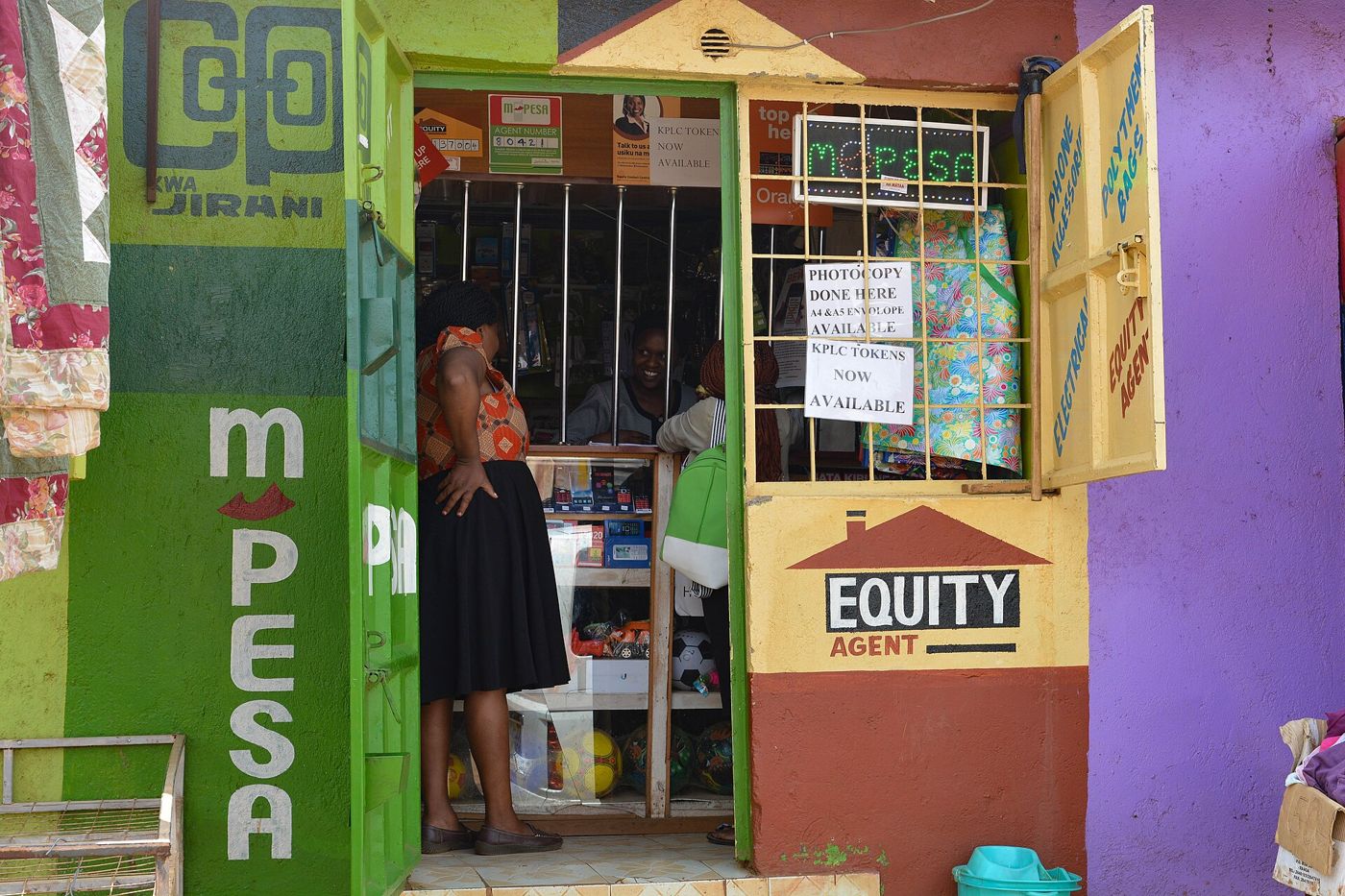
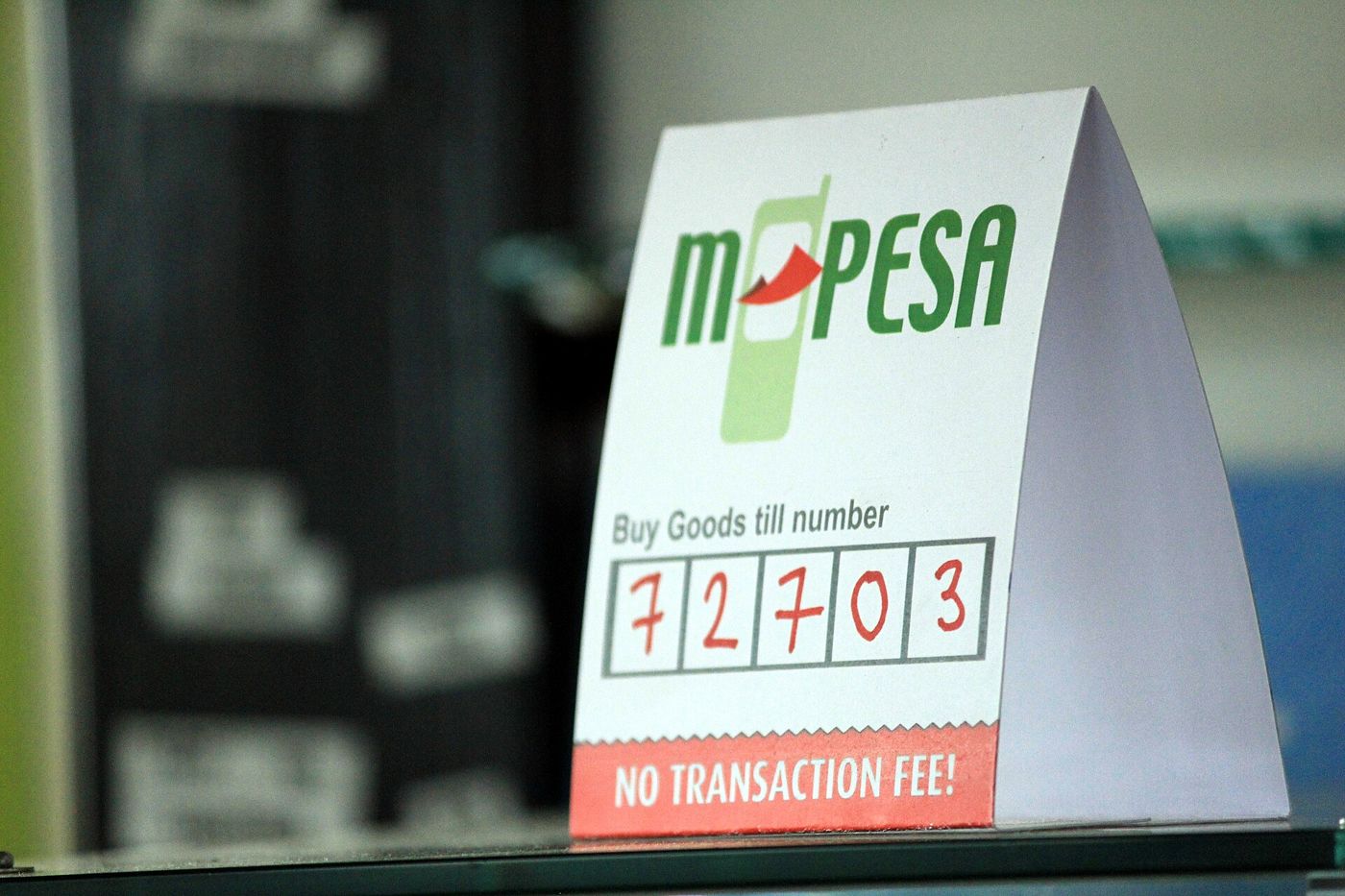
- Merchant acceptance at parity. Kenyan businesses overwhelmingly quote prices in M-Pesa terms (Paybill and Till numbers) by default. For Airtel Money to become a true substitute rather than a supplement, merchants have to accept it by default, without friction. This is a slower, behavioural shift than a pricing one, and the trend is running the other way: the national agent count fell by about 34,000 to 568,463 in the April–June 2026 quarter as users moved from cashing out to paying merchants digitally, which deepens Lipa na M-Pesa’s hold.
- A credit product to match Fuliza. M-Pesa’s overdraft product, Fuliza, is a major retention lever that Airtel Money still lacks at comparable scale. Credit habituates users to a wallet in a way pure payments do not.
- A savings product to match Ziidi. Safaricom is now layering wealth products onto the wallet. Its Ziidi money market fund, launched inside M-Pesa in January 2025, more than doubled its assets to KSh 18.7 billion in the year to March 2026. By September 2025 it counted about 1.15 million investors, roughly 48% of all individual unit-trust investors in Kenya. A user may send money on Airtel to save a few shillings, but will not easily abandon the wallet that holds their interest-earning savings.
- Regulatory tailwinds. The Competition Authority of Kenya’s July 2014 ruling ended M-Pesa agent exclusivity, freeing Safaricom’s roughly 85,000 agents at the time to serve competitors. Account-to-account interoperability between wallets followed in 2018. Both were meaningful structural assists to Airtel, and further mandated interoperability or agent-sharing rules would help any challenger more than incumbent-friendly regulation.

Starlink: hype, reality and an unexpected pivot to partnership
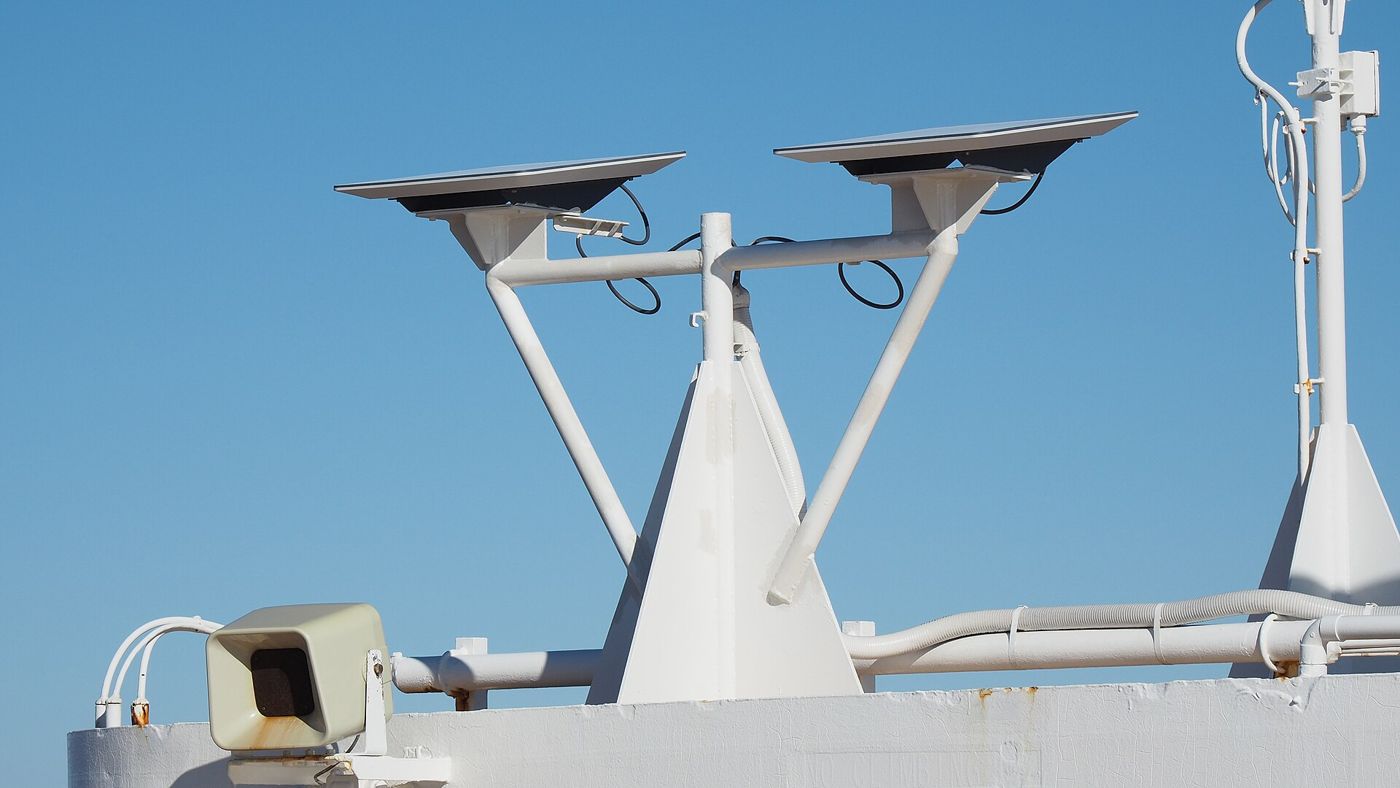
Starlink launched commercially in Kenya in July 2023 and has generated a disproportionate amount of media attention relative to its actual market share. Communications Authority data places the low-Earth-orbit provider as Kenya’s eighth-largest fixed internet provider, with 27,616 subscriptions in June 2026. That is 99.7% of all satellite connections in the country but only about 1.0% of the fixed market.
Starlink’s growth has not been smooth. The service froze new urban sign-ups for seven months (November 2024 to June 2025) because of network congestion, easing after a local ground station came online in early 2025 and cut latency from about 120 ms to about 53 ms. In early July 2026 it paused sign-ups again in seven counties (Nairobi, Kiambu, Mombasa, Machakos, Murang’a, Kirinyaga and Kwale), citing capacity. Pricing also works against it in Kenya’s price-sensitive market. Even the Starlink Mini kit (KSh 27,000), or the rental option (KSh 2,700 activation plus KSh 1,950 a month for hardware, with plans from KSh 1,300 for 50 GB), remains expensive compared with Safaricom’s 5G router (about KSh 2,999 upfront) or Poa Internet’s unlimited home Wi-Fi at KSh 1,575 a month. Regulatory costs have risen sharply too. In April 2026 the CA gazetted a revised market structure that replaces the old flat satellite landing-rights licence (about US$12,500) with an International Gateway Systems and Services licence costing KSh 15 million for 15 years or KSh 45 million for 25 years, plus an annual fee of 0.4% of gross turnover (minimum KSh 4 million).

The unexpected pivot: Safaricom and Starlink are now partners
The most consequential Starlink development in Kenya is not competitive at all but collaborative. In November 2025, Vodacom Group (Safaricom’s parent) signed an Africa-wide agreement with SpaceX that lets its subsidiaries, Safaricom included, resell Starlink equipment and services to enterprise and small-business customers and use Starlink to extend rural coverage. That is a sharp turn for an operator that had openly opposed Starlink’s entry. Safaricom CEO Peter Ndegwa has framed it explicitly: satellite should complement, not compete with, terrestrial infrastructure. Separately, Airtel Africa and SpaceX completed tests of Starlink’s Direct-to-Cell service in Kenya in March 2026, with ordinary 4G smartphones connecting to satellites without a dish. As of August 2026, Airtel says the service is ready and is waiting for CA approval while the regulator assesses interference risks. The aim is to extend coverage into areas that terrestrial towers can’t reach economically.
The fast-emerging smaller ISPs: the underappreciated competitive frontier
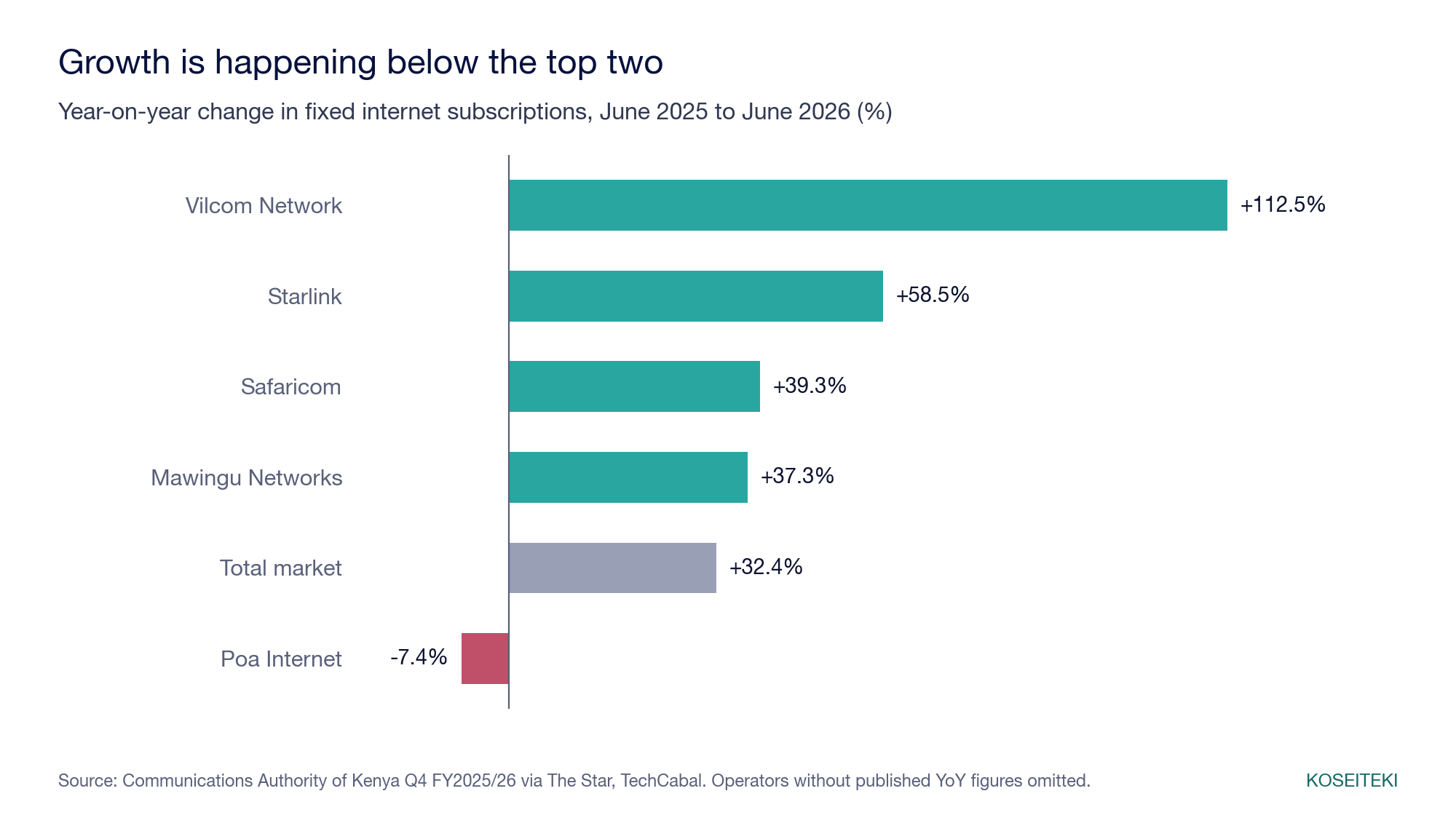
If there is a single underappreciated story in this landscape, it is the tier of ISPs below Safaricom and JTL: Poa Internet, Wananchi Group (Zuku), Ahadi Wireless (operating as Konnect), Vilcom Network, Mawingu Networks and many other emerging home and street-connection ISPs. As a group, these operators are growing faster in percentage terms than either of the two market leaders, and the reshuffling beneath the top two is arguably more dynamic than anything happening at the top.
The clearest recent example: Ahadi Wireless (Konnect) overtook Poa Internet in the April–June 2026 quarter to become Kenya’s fourth-largest fixed internet provider, reaching 270,586 subscriptions and a 9.5% share. Poa’s subscriber base fell 3.1% quarter-on-quarter to 248,601 (8.8%), its fourth consecutive quarterly decline from a June 2025 peak of 268,554. Vilcom Network recorded the fastest growth of any major provider in the same period, more than doubling its subscriptions year-on-year from 87,654 to 186,240 and lifting its share to 6.6%. Mawingu grew 37.3% to 105,275 subscriptions. For comparison, Starlink, despite its outsized media profile, grew 58.5% but only to 27,616 subscriptions, smaller than every operator named in this paragraph.
What’s powering the fast emergence of smaller ISPs
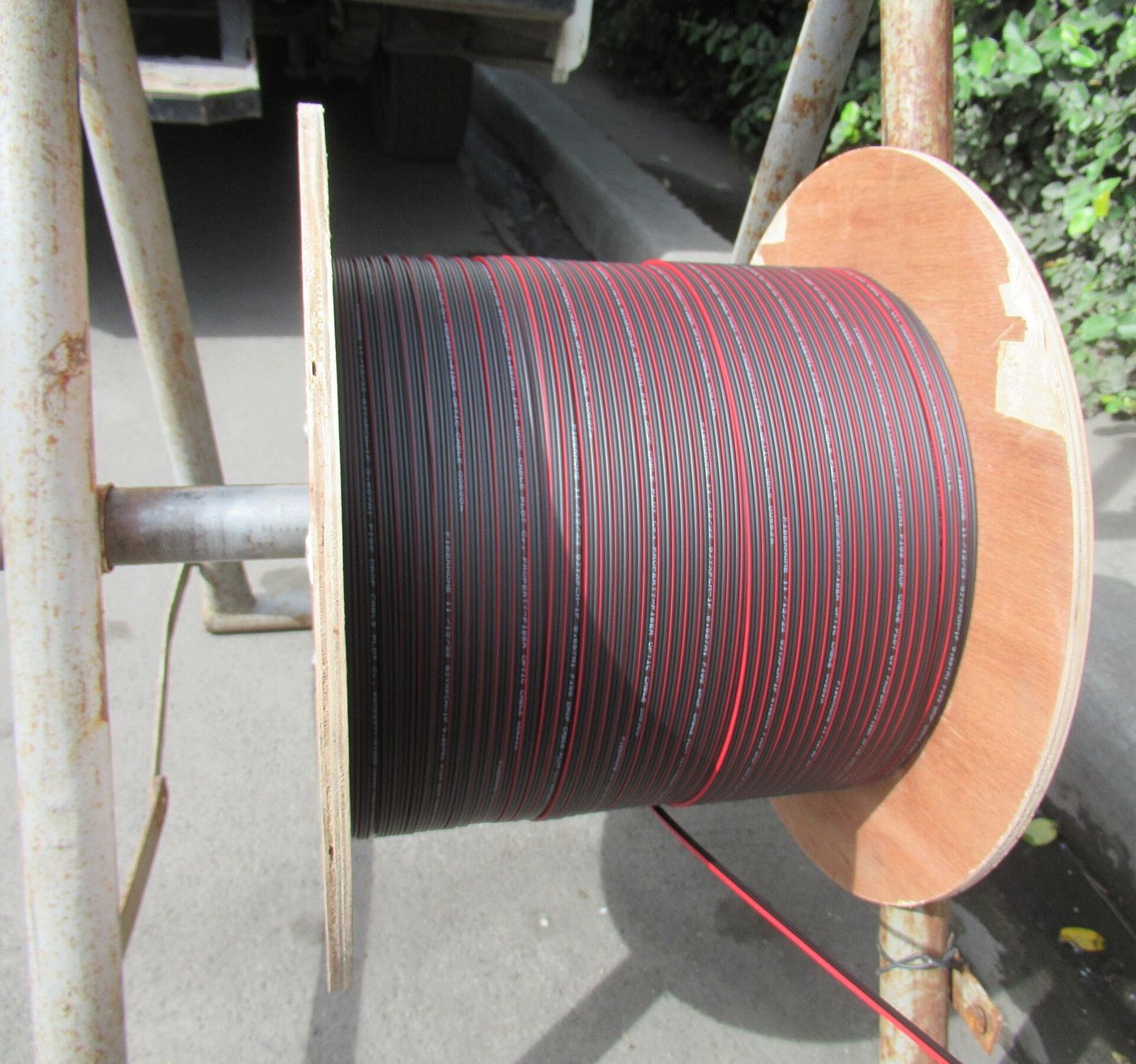
- Fibre subscriptions grew 29.7% year-on-year to 1.57 million and remain the dominant fixed-access technology. Small ISPs that committed early to fibre-to-the-home builds rather than fixed wireless are capturing a disproportionate share of this growth. Terrestrial wireless grew even faster, up 42.9% to 1.03 million, while copper DSL has all but vanished (23 lines nationwide).
- Falling device and equipment costs are lowering the capital barrier for households to switch providers. That intensifies price-based churn among the smaller operators in particular; the leaders are more insulated by brand and coverage breadth.
- Total fixed-market growth is outpacing operator-level growth almost everywhere except at Safaricom and among the fastest risers. The overall market expanded 32.4% year-on-year to 2.84 million, faster than most individual smaller operators. So even players that are losing share are often still adding subscribers in raw terms; they are just losing the race for new customers.

What this means for the landscape going forward
The small-ISP tier is where genuine, fast-moving competition exists in Kenyan telecoms today. Market positions inside this tier are shifting meaningfully from quarter to quarter, in a way the top of the mobile market (Safaricom, Airtel, Telkom) has not seen in over a decade. This has three implications worth tracking:
- Consolidation is likely, and has already started. Axian’s purchase of Wananchi (Zuku) shows that a well-capitalised buyer will pay for scale in Kenyan fixed broadband. A fragmented tier of six-plus operators, each with a single-digit share and growing at wildly different rates, is a textbook setup for further M&A. A stronger player (Vilcom, on its current trajectory) acquiring a weaker one (Poa, on its current trajectory) is a more probable near-term event than any single small ISP independently challenging JTL for the number-two position.
- This tier, not Starlink, is Safaricom’s real medium-term competitive risk in fixed broadband. Safaricom’s fixed share dipped from 35.6% to 34.9% between September and December 2025 even as its subscriber count grew, meaning the market briefly outgrew Safaricom’s ability to capture it. Safaricom has since recovered to 36.1% on 39% annual growth, so the contest is live in both directions rather than settled.
- None of this touches mobile money or core voice/SMS. The small-ISP boom is a fixed-broadband phenomenon only. It says nothing about whether anyone can challenge Safaricom’s 69.8% mobile share or 88.8% M-Pesa share, which are governed by entirely different competitive dynamics.
What to watch through 2027
- The Court of Appeal on Safaricom’s ownership. Whether Vodacom’s majority control stands, and on what terms.
- The 2026 mobile termination rate review. Rates were cut from KSh 0.99 to 0.58 per minute in 2022 and to KSh 0.41 in March 2024. A further cut would make Airtel’s cross-network voice bundles cheaper to offer.
- CA approval of Airtel’s Starlink Direct-to-Cell service, the first satellite-to-phone service in the market, and whether Safaricom follows with its own.
- Axian’s capital spending in Zuku. Whether the new owner turns Kenya’s number-three fixed player into a price-setter.
- Satellite capacity and new entrants. Whether Starlink’s urban capacity pauses persist, and how Amazon’s reported April 2026 licence application for its satellite service progresses.
- An Airtel Money credit product. The clearest signal that Airtel is moving from share-taker to genuine rival.
The honest caveat
This analysis draws on Communications Authority of Kenya quarterly sector statistics (through the April–June 2026 quarter, published in September 2026), Safaricom’s own FY2026 results and historical disclosures, and secondary reporting from the Kenyan business and tech press. It does not draw on primary regulatory filings for every operator: Airtel Africa’s and Telkom Kenya’s own financial disclosures were not directly reviewed, and their numbers here come via CA aggregation and press reporting. Pre-2023 market-share figures in Figure 3 come from Safaricom’s own published history and are not strictly comparable with the CA’s quarterly series. Market-share figures also fluctuate from quarter to quarter: several of the percentages cited (Safaricom’s fixed-broadband share, Airtel Money’s mobile money share) moved by a full percentage point or more between adjacent quarters in 2025–2026, so treat any single figure as a snapshot rather than a stable constant. The Starlink–Safaricom partnership framing rests on statements from both companies’ leadership and on Vodacom’s November 2025 agreement. It should be watched as satellite technology and Direct-to-Cell service mature: a much more capable and cheaper Starlink in 2028–2030 could revive the disruption thesis this piece currently discounts.
Sources cited
- Communications Authority of Kenya, Sector Statistics Report Q4 FY2025/26 (April–June 2026) and earlier quarterly releases
- Safaricom PLC, FY2026 Annual Results (7 May 2026); coverage via People Daily, tech-ish, The Kenya Times, Kenyan Wallstreet, Eagle News Feed
- Safaricom PLC, “Our Safaricom journey” (Annual Report 2022), historical market share, subscribers and revenue
- Citizen Digital, “Safaricom gains 5.5 million subscribers as Kenya’s mobile market hits 84.1 million” (June 2026)
- TechTrendsKE, “Safaricom market share rises in Kenya as broadband, M-Pesa shares dip” (September 2026)
- The Business Watch, “Safaricom adds 10 million lines in a year as Airtel’s base shrinks” (September 2026)
- People Daily, “Kenya’s mobile SIM subscriptions hit 88 million in Q4 FY 2025/2026” (September 2026)
- The Star, “Safaricom crosses one million fixed internet mark as broadband race intensifies” (September 2026)
- The Star, “Market share in domestic mobile voice and SMS traffic” (September 2026)
- TechCabal, “How Safaricom built Kenya’s biggest home internet business” (September 2026)
- tech-ish, “Kenya’s 2025 in numbers” (April 2026); “Kenya has 54 million active mobile money accounts” (September 2026)
- The Kenyan Wallstreet, “Airtel Money hits record 11.1% share as M-Pesa slips” (June 2026)
- The Star, “Airtel Money hits double digit market share as M-Pesa drops below 90%” (December 2025)
- MarketScreener, “Kenya mobile money landscape diversifies as Airtel passes 10% threshold” (December 2025)
- Business Daily, “Telkom sheds 160,000 subscribers as market share declines further” (2026)
- TechMoran and tech-ish, “Airtel Money gains access to KCB’s 22,000-agent network” (June 2026)
- Capital FM and TechCabal, Ziidi Money Market Fund results and assets (April–May 2026); Business Daily on Ziidi investor share
- CGAP, “Agents for everyone: removing agent exclusivity in Kenya and Uganda”; Techweez, “Airtel wins case to compel Safaricom to open up M-Pesa agency network” (July 2014)
- Axian Telecom, “Yas completes acquisition of Wananchi” (November 2025); Khusoko and Techweez coverage
- Techweez, “Safaricom co-owner Vodacom partners with Starlink for Africa internet expansion” (November 2025); Daily Nation, “Safaricom makes peace with Elon Musk’s Starlink”
- TechTrendsKE and tech-ish, Airtel–Starlink Direct-to-Cell testing and approval status (March and August 2026)
- tech-ish, “Starlink passes 27,000 subscribers in Kenya” (September 2026); Capital FM, “Starlink adds 10,191 customers in Kenya” (September 2026)
- tech-ish, “Kenya’s satellite operators now face up to KES 45 million in licensing fees” (April 2026)
- Space in Africa, “Starlink Kenya records 14% quarterly growth, reaching 22,282 subscribers” (April 2026)
- Khusoko and Kenyan Wallstreet, Starlink Mini pricing (September 2024); tech-ish, Safaricom 5G router review; Poa Internet published plans
- Capital FM, connectingafrica.com and business.co.ke, Vodacom’s Safaricom stake purchase and the High Court ruling (December 2025 to September 2026)
- ITWeb Africa and TechTrendsKE, Kenya mobile termination rates (2022–2026)
- Business Daily, “Ownership changes leave Merali as face of Kencell”; Telecompaper and Nation on Econet Wireless Kenya and Essar/yu; Wikipedia, Telkom Kenya
- The Standard, “Why Airtel, Telkom have failed to whittle down Safaricom market share” (2018)
Image credits
- M-PESA mobile money and Equity agent, Nairobi, Kenya.jpg, Fiona Graham, CC BY-SA 2.0, Wikimedia Commons
- An M-Pesa Payment Till.JPG, Raidarmax, CC BY-SA 3.0, Wikimedia Commons
- Starlink Dish 20250111 101122.jpg, Ka23 13, CC BY 4.0, Wikimedia Commons
- 10 Technological Advantages of Masts for a Nation.jpg, Director Mtonga Kenya, CC BY-SA 4.0, Wikimedia Commons
- Optic fiber cables 01.jpg, SwarmCheng, CC BY-SA 4.0, Wikimedia Commons
- Safaricom Centre.jpg, Nairobi123, CC BY-SA 4.0, Wikimedia Commons
- Header photo: as above (10 Technological Advantages of Masts for a Nation.jpg). Charts: Koseiteki, from the sources listed.
