A Koseiteki Deep Dive · Trade, Minerals and Manufacturing
The Real Anatomy of East Africa's Non-Agricultural Exports to China and the West
Sources: KNBS via Business Daily; Kenya Ministry of Trade; Bank of Uganda; Bank of Tanzania.
The lead case: Corning and Revital Healthcare
On August 7, 2025, Corning Incorporated, the New York-headquartered materials science company best known for Gorilla Glass and fiber optics, signed a letter of intent with Revital Healthcare to jointly build a life-sciences manufacturing footprint in Africa. Revital is a Kenyan medical devices and laboratory consumables manufacturer based at Kikambala, north of Mombasa; it describes itself as Africa’s largest medical device manufacturer and exports to more than 28 countries.
The structure is a genuine division of labour rather than a straightforward export relationship. Revital brings its existing EPZ facilities, its regulatory track record (its products carry WHO prequalification, which matters for UN and donor procurement) and its pan-African distribution network. Corning brings its Life Sciences division’s manufacturing know-how and supply-chain expertise. The stated first product category is laboratory consumables, with plans to widen the product range as the partnership matures. The letter of intent is non-binding, and neither company has published a timeline or investment figures.
Revital’s own expansion gives a sense of what “scale” means here in dollar terms, and it is modest. IFC has disclosed a proposed 10-year senior loan of about $10 million (KSh 1.3 billion) toward a reported $23.4 million expansion: more kitting and cold-chain capacity at Kikambala, and a new logistics and warehousing hub on a 20-acre plot in the Dongo Kundu Special Economic Zone in Mombasa. The balance would come from internal cash and a joint-venture partner, and IFC’s board consideration is tentatively set for 5 November 2026. That is a single mid-sized factory expansion, not a trade flow that moves a balance-of-payments line. Corning–Revital is a high-quality example of a Western technology company embedding itself in African manufacturing rather than simply sourcing from it, but it is one deal, pre-investment, with no disclosed capital figure from Corning’s side. Call it a template, not yet a trend.
A more typical Western case: Royal Apparel EPZ and the IFC
On January 27, 2025, the International Finance Corporation (the World Bank Group’s private-sector lending arm) announced $15 million in financing for Royal Apparel EPZ Limited, a garment manufacturer building a new, automated, EDGE-certified factory near Nairobi. $10 million comes from IFC’s own account; the remaining $5 million comes through the Canada-IFC GROW facility (Advancing Gender Equality, Resilience, Opportunity, and Inclusion Worldwide), in what IFC’s release describes as the first investment to draw on that gender-focused fund. The factory is projected to create roughly 3,700 jobs, mainly for women (later IFC audio material cites about 4,500). It is explicitly export-oriented, supplying apparel to major US and global fashion brands through the same AGOA-enabled channel that already carries the large majority of Kenya’s non-agricultural exports to the West.
The contrast with Corning–Revital is instructive. Corning is a named industrial company lending its own brand, technology and supply-chain relationships to a joint manufacturing venture. The IFC is a multilateral development lender financing a Kenyan-owned factory that will go on selling into Western retail brands under its own name, with the brands themselves nowhere near the deal structure. Both count as “the West building non-agricultural manufacturing capacity in Kenya,” but they are different mechanisms. A reader hoping to find more cases like Corning’s (an industrial company co-branding with an African manufacturer) should expect to find far more cases that look like Royal Apparel’s (development finance underwriting an export factory that still sells under AGOA’s apparel umbrella).
What China actually buys from Kenya, outside agriculture
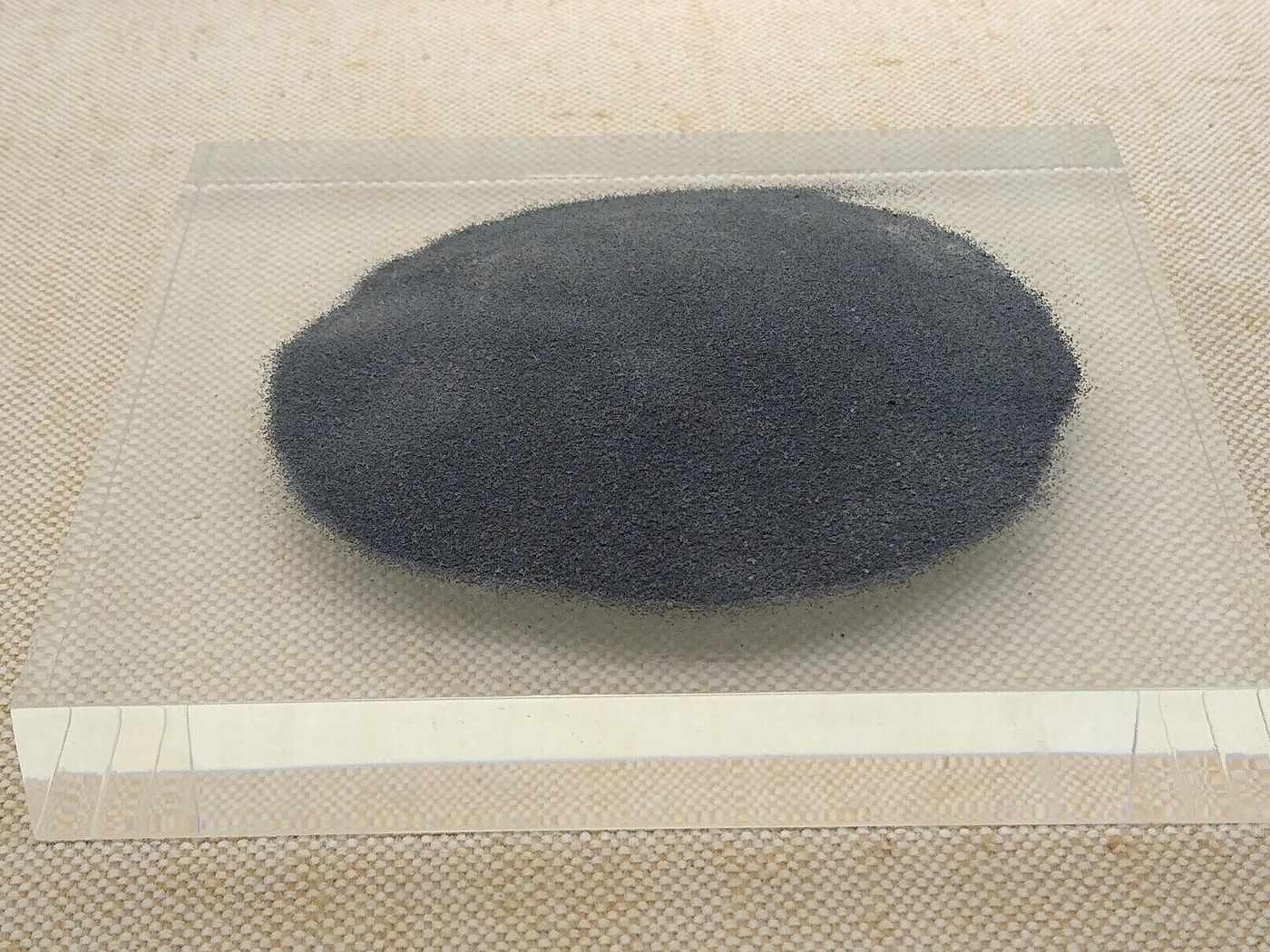

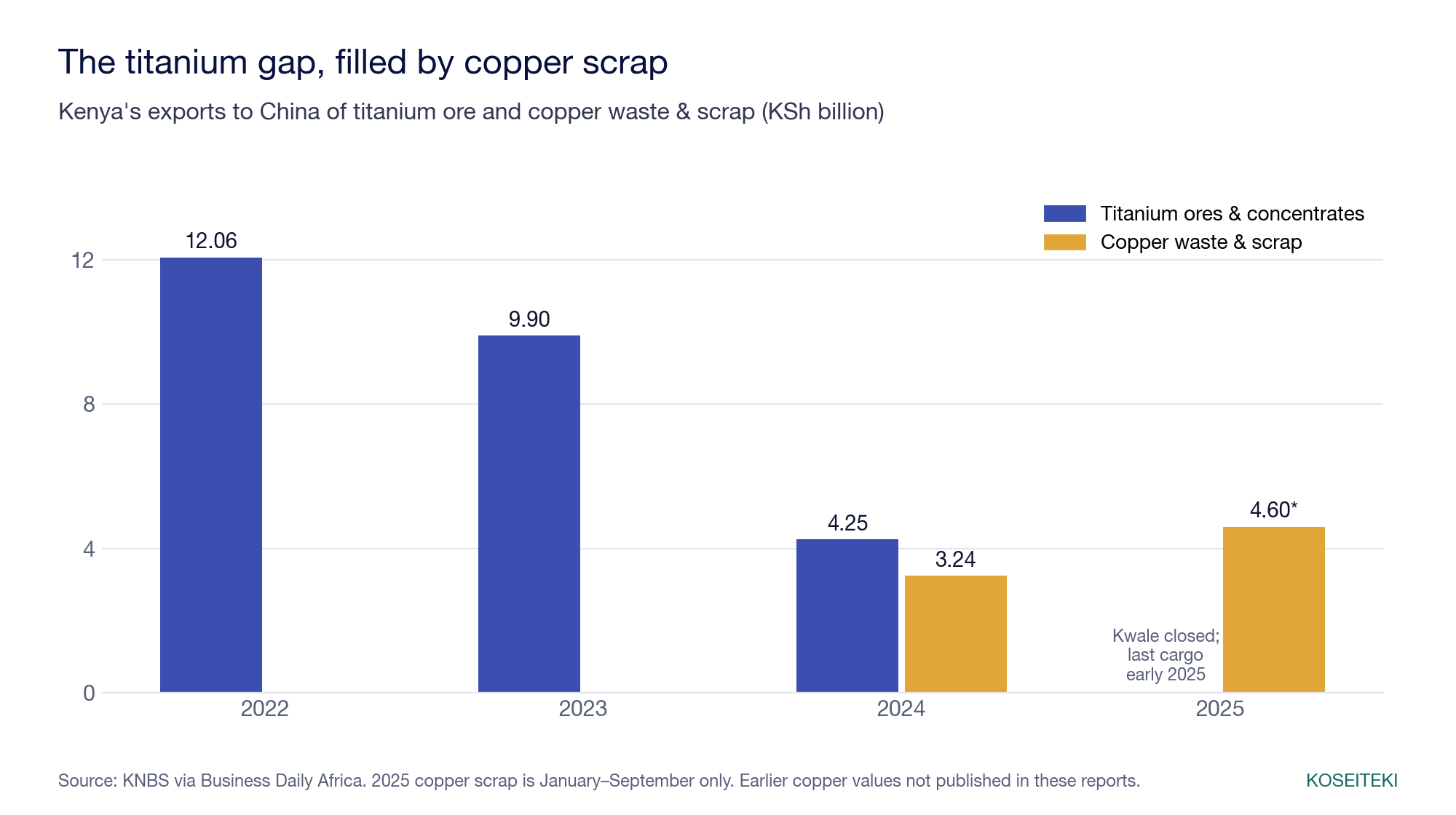
Kenya’s exports to China have now fallen two years running. They fell 9.1% to KSh 26.3 billion in 2024, then 35.7% to KSh 16.9 billion in 2025, the steepest fall in at least a decade. The single largest driver was the end of mining at Base Titanium’s Kwale mine in December 2024; it had been Kenya’s largest titanium ore exporter and a major China-bound supplier. Titanium ore shipments to China fell from KSh 12.06 billion in 2022 to KSh 9.90 billion in 2023 and KSh 4.25 billion in 2024, and the last consignment left in early 2025. (Macadamia nuts, an agricultural line outside the scope of this piece, also contributed to the 2025 fall.)
With that mine shut, the composition of what’s left shifted. Copper waste and scrap became Kenya’s single largest export to China in 2025, worth about KSh 4.6 billion in the first nine months of the year against KSh 3.24 billion for the whole of 2024. Business Daily attributes the jump partly to the titanium gap and partly to tighter domestic controls on raw ore exports pushing traders toward scrap metal instead. Zirconium ores and concentrates, a co-product of the same Kwale mineral-sands operation, were a meaningful China-bound line until the closure: in 2024 China took 62% of Kenya’s roughly $31 million of zircon exports. With Kwale shut, that line has largely dried up too.
The strategic footnote to the titanium story lies in who acquired the asset base. Energy Fuels, a US uranium and rare-earths producer, completed its all-share acquisition of Base Resources in October 2024, in a deal valued at about $178 million. The main prize was Base’s Toliara project in Madagascar (since renamed Vara Mada), whose monazite-bearing mineral sands fit squarely into the United States’ push to build a domestic rare-earth supply chain. Kwale came with the deal at the very end of its mine life. At the time of writing, the transaction has not translated into resumed mining in Kenya or any new shipments to China or Western markets. A Western company now owns what remains of the infrastructure that once fed Kenya’s largest China-bound industrial export, but the Kenyan asset is in a post-mining, rehabilitation and exploration phase.
China’s own posture toward Kenya shifted in 2026. From 1 May, Beijing removed tariffs on goods from the 53 African countries with which it has diplomatic ties. For Kenya the arrangement runs through an Early Harvest Agreement covering about 98% of its exports, and for countries that are not least-developed, Kenya included, it is expected to last until 30 April 2028. Beijing framed the offer as an incentive for Kenya to diversify beyond raw minerals into processed or value-added goods, yet the priority products named so far are agricultural: tea, coffee, avocados and macadamia. Whether Kenyan exporters can actually use that access for non-agricultural, non-mineral goods is unproven. The offer is new enough that there is no trade data yet showing it has changed the mix.
What the West actually buys from Kenya, outside agriculture

The United States’ main lever is the African Growth and Opportunity Act (AGOA). The programme lapsed on 30 September 2025, was renewed for one year in February 2026, and in September 2026 was extended through 31 December 2028, with duties paid during the gap refundable. In practice AGOA’s Kenya story is almost entirely a textile story. Apparel accounts for roughly 70% of Kenya’s exports to the US, built on the Export Processing Zone garment sector around Nairobi and Athi River, which directly employs more than 66,000 people. Outside apparel, AGOA-linked exports have included titanium ores, while the Kwale mine was operating, and some pharmaceutical products, but neither comes close to apparel’s share.
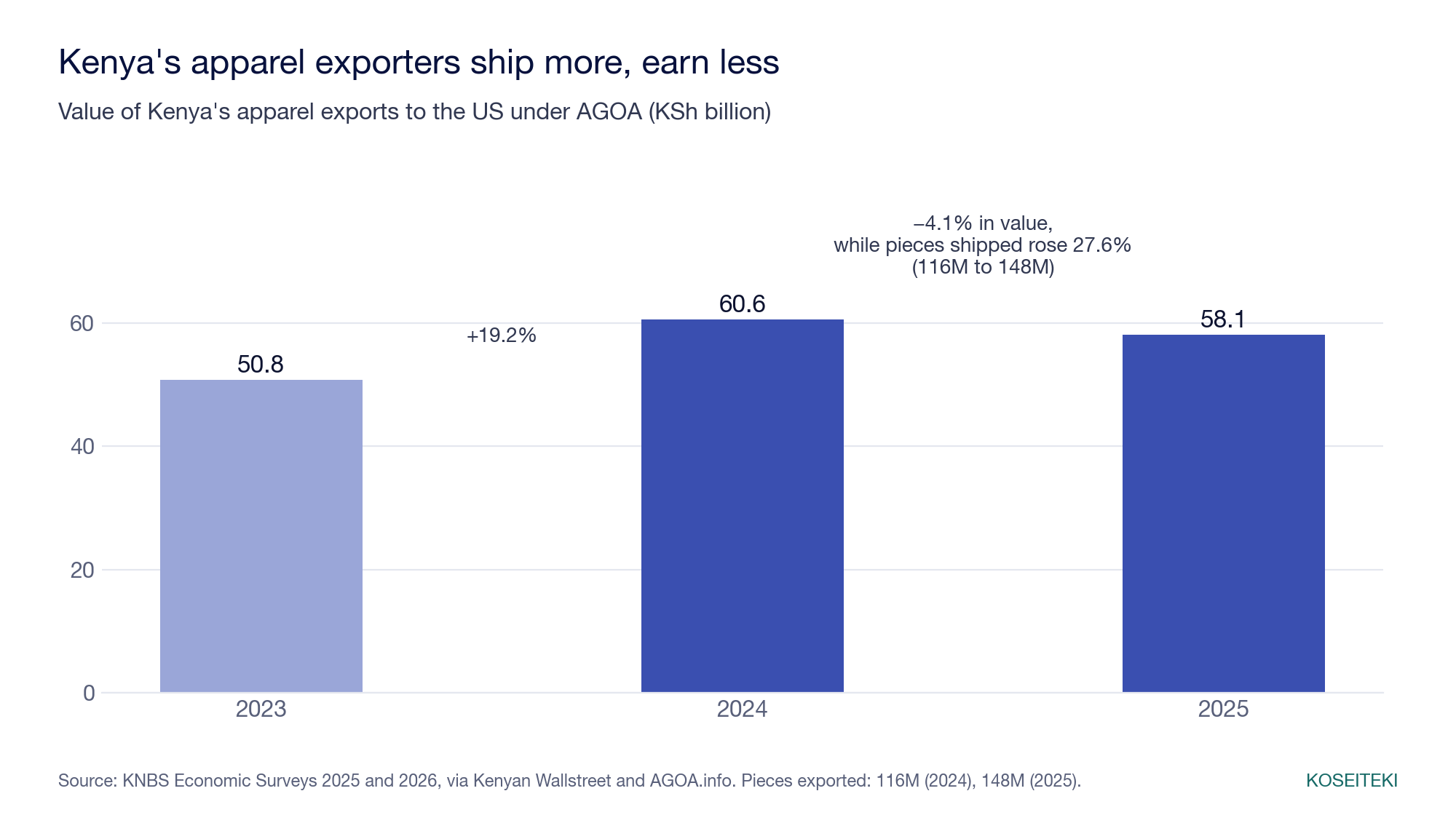
That channel is growing in volume but not in value. Kenyan factories shipped a record 148 million apparel pieces to the US in 2025, up 27.6% on the year, yet earnings fell 4.1% to KSh 58.1 billion, from KSh 60.6 billion (about $470 million) in 2024. On the US side, total goods imports from Kenya came to $862 million in 2025.
The more consequential non-trade development is strategic rather than commercial. Mrima Hill, in Kenya’s Kwale county, holds a rare-earths and niobium deposit that Cortec Mining Kenya estimated in 2013 at $62.4 billion in in-ground value. Kenya later revoked Cortec’s licence, and no feasibility study has been published. Washington has taken explicit, public interest in the deposit, pledging to help Kenya process its minerals at home. That interest only makes sense against the backdrop of China’s roughly 90% share of global rare-earth processing capacity, which gives Beijing leverage over supply chains for magnets, EVs and defence electronics that Washington is actively trying to diversify away from. Kenya opened the deposit to tender in March 2026. By July, a consortium led by US-listed Critical Metals Corp was one of three finalists from seven bidders, although Mining Principal Secretary Harry Kimtai spoke in September of six shortlisted firms, two of them American. No award date has been set. As with Corning–Revital, this is a real and well-sourced development, but it sits upstream of trade: a tender is not a mine in production, and nothing in the public record yet shows rare earths moving from Mrima Hill to a Western buyer.
One curiosity in AGOA-adjacent trade data deserves a flag rather than a conclusion. Kenya’s export statistics show an anomalous entry for semiconductor exports to the US, a category Kenya has no known domestic semiconductor manufacturing base to support. The most plausible explanation is a transshipment or re-export classification artifact rather than a real Kenyan semiconductor industry. This could not be verified against the underlying transactions, so it is flagged here as a data-quality note rather than a finding: a candidate for a follow-up query to KNBS or US Census Bureau trade data directly, rather than something to repeat as an established figure.
A different kind of China–Kenya development belongs here as context, not as an export item. On October 6, 2026, President Ruto presided over a $3 billion (KSh 389 billion) memorandum of understanding between Kenyan firm Endelevu Enterprise Corporation and Chinese automaker Geely. It covers a planned 50,000-unit-a-year four-wheel EV assembly plant, a 100,000-unit two-wheeler plant, 1,000 solar charging hubs and a vehicle management platform, with about 2,000 direct jobs projected. President Ruto himself was explicit that it is a framework MOU, not a binding investment, and urged a quick move to definitive agreements. The deal inverts the direction of flow in this piece: Chinese capital and technology are coming into Kenya to manufacture for the Kenyan and East African Community market, rather than Kenya exporting raw material to China. It belongs next to the beat, not inside it.
Uganda: gold dominates, but most of it isn’t Uganda’s
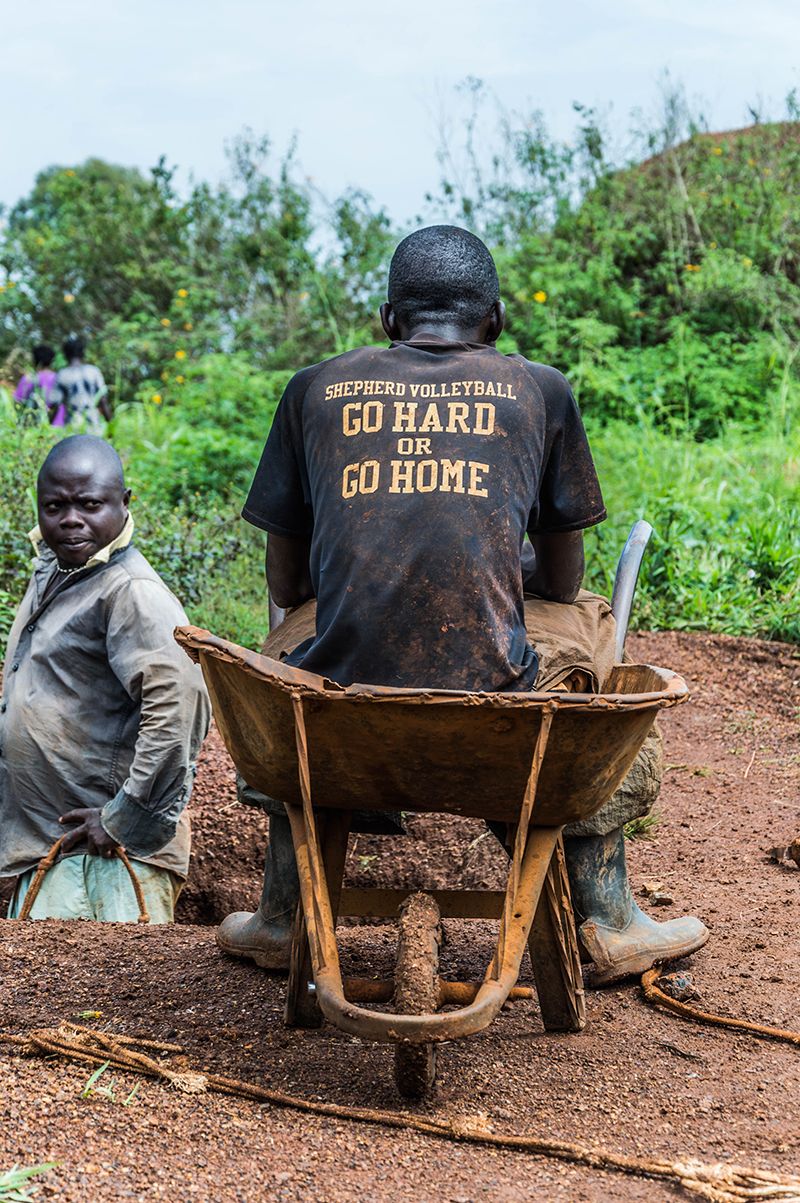

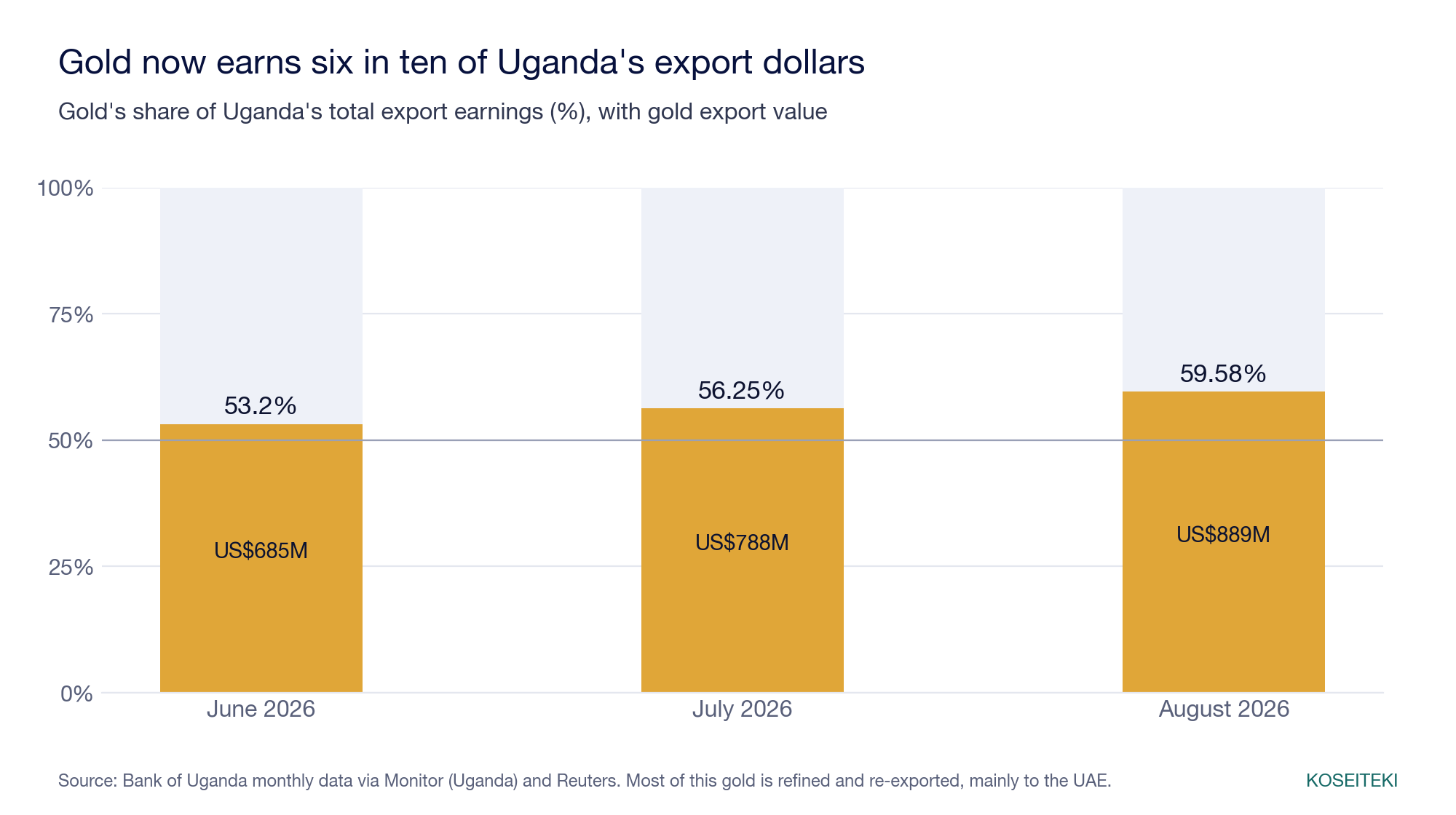
Gold is overwhelmingly Uganda’s largest export. Per Bank of Uganda data, it accounted for 59.58% of total export earnings in August 2026, up from 56.25% in July and 53.2% in June. In dollar terms, gold earned $889 million in August, out of roughly $1.5 billion in total exports. The complication is that most of that gold is not mined in Uganda. Uganda has become a regional gold refining and re-export hub, processing gold mined in the Democratic Republic of Congo and other neighbours and re-exporting it as Ugandan origin, which is a different economic story from domestic resource extraction. It’s a services and logistics business wearing a commodity export label. It is also worth noting where the gold goes: in August, 53.8% of Uganda’s exports went to the Middle East, mostly gold sold to the United Arab Emirates, not to China or the West.
Domestic gold mining capacity does exist and is growing. The Wagagai gold mine in Busia District, owned by Wagagai Mining (U) Ltd, a subsidiary of China’s Liaoning Hongda, represents roughly $250 million in investment. President Museveni commissioned it in August 2025 as Uganda’s first large-scale gold mine, targeting about 1.2 tonnes of refined gold a year. It is one of the few cases found here of a Chinese company directly operating extraction infrastructure in East Africa rather than simply buying the output. That’s a meaningfully different relationship from the Kenya pattern of China buying ore or scrap at arm’s length: it’s upstream vertical integration.
On the Western side, Uganda has no binding bilateral US trade deal and has been AGOA-ineligible since January 2024, when it was removed from the programme over human rights and governance concerns. That closed off the main unilateral tariff-free channel the US has used to structure African trade. What has replaced it so far is thinner than it sounds. On September 25, 2026, at a UN General Assembly week showcase in New York hosted by Deputy Secretary of State Christopher Landau, the US unveiled the Roosevelt Africa Trail as the first project under its “Trade Over Aid” framework: an indicative $1.2 billion pipeline named for Theodore Roosevelt’s 1909–10 East Africa expedition. The pipeline covers a history museum, a resort, AI-driven “smart monument” tourism infrastructure, and a venture to move Uganda’s coffee exports from raw beans into roasted, branded products for the US market. Crucially, the $1.2 billion has not been approved or disbursed. Organisers acknowledged that no US institution, EXIM and the DFC included, has committed it, and the projects still need feasibility studies, due diligence and financing decisions. It is real, but it is tourism and coffee-branding infrastructure at the pipeline stage, not an industrial trade corridor, and nothing like an AGOA replacement yet.
Tanzania: graphite is the headline, gold is the real number
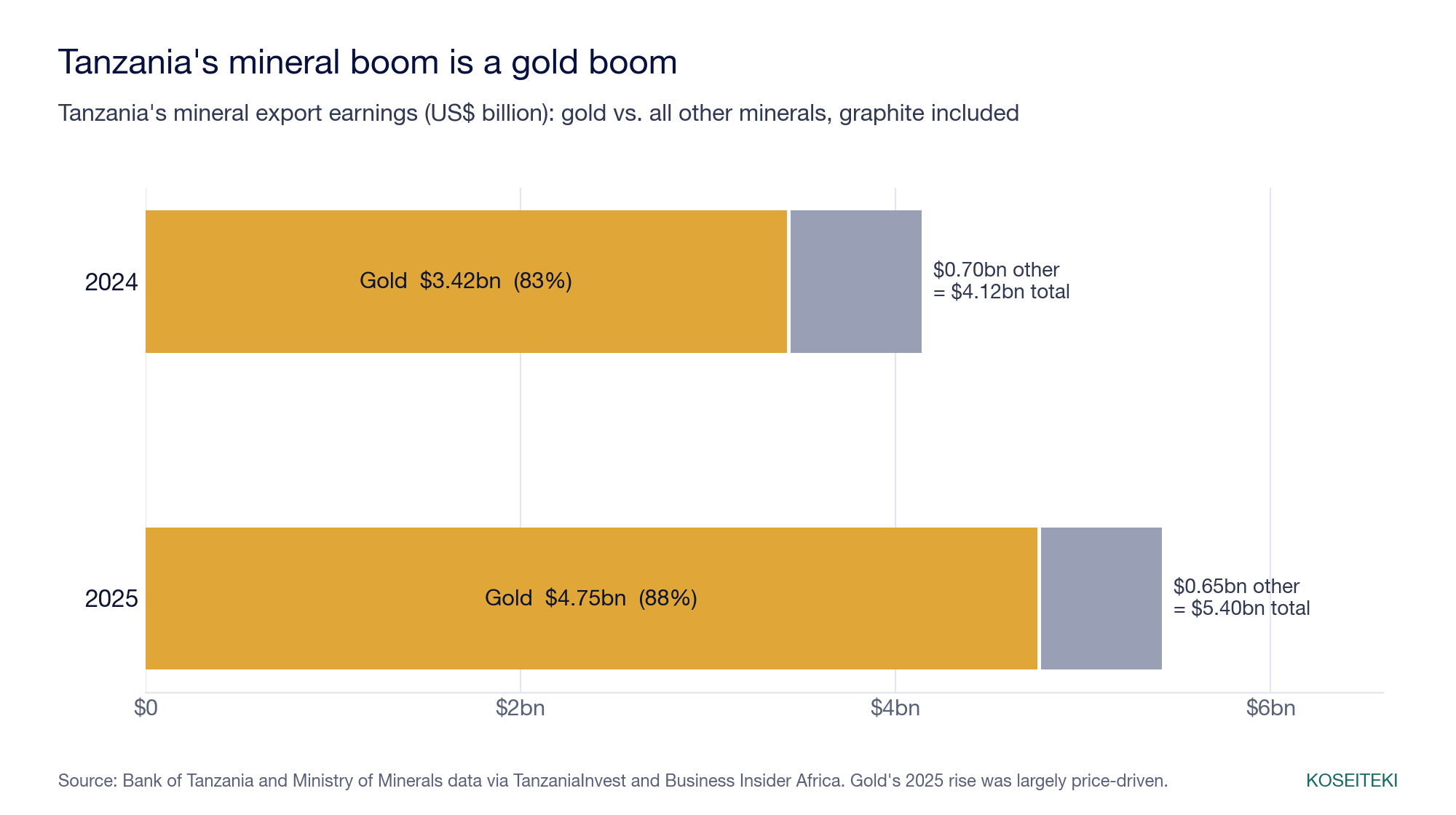
Tanzania’s mineral export earnings rose from about $4.1 billion in 2024 to $5.4 billion in 2025, roughly 31% growth, and minerals now make up more than half of the country’s goods exports. Within that, gold is the dominant line: about $4.75 billion in 2025, or 88% of mineral export value, a rise driven largely by a 66% jump in the gold price. Graphite gets most of the critical-minerals attention. Tanzania holds about 6% of the world’s known graphite reserves, is already the world’s sixth-largest producer (about 25,000 tonnes a year from two large mines) and sits on every Western and Chinese critical-minerals list as a battery anode input. But graphite’s actual share of Tanzania’s export revenue today is small next to gold’s. The gap between strategic significance and current trade volume is the same pattern seen at Mrima Hill in Kenya: real geological endowment, real strategic interest, not yet a real trade flow.
Despite AGOA eligibility, the US is a small market for Tanzania: US goods imports from Tanzania came to about $242 million in 2025, roughly 2% of Tanzania’s goods exports. Tanzania’s AGOA trade is itself mostly textiles and apparel, but on a small scale (about $85 million in 2023), a fraction of Kenya’s. That’s a useful number to hold against the apparel-dominated AGOA story in Kenya: eligibility alone does not generate meaningful US trade without an export sector positioned to use it, and Tanzania’s mining-heavy export base has not built the same apparel channel into the US market that Kenya’s EPZ sector has.
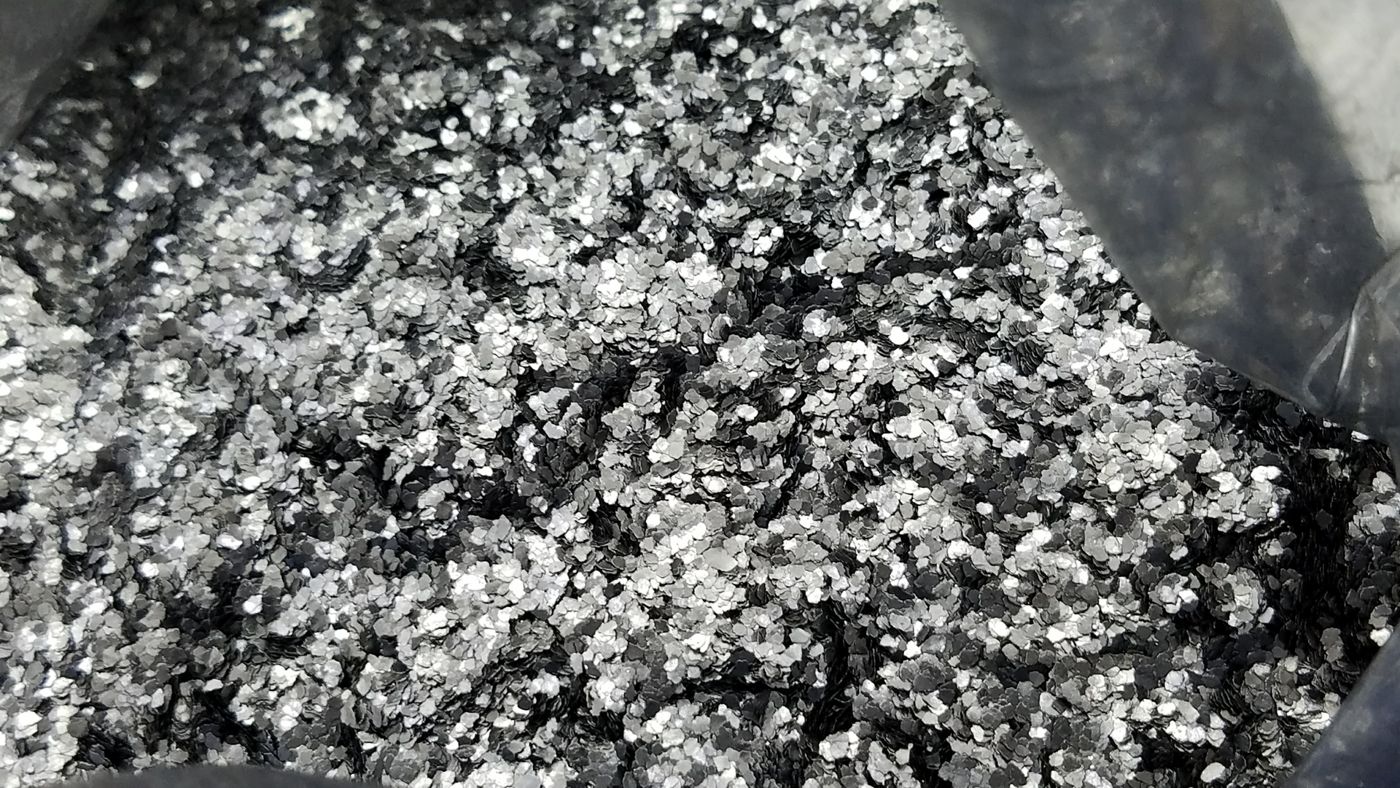

What Tanzania does have, verified and current, is a cluster of Chinese joint ventures moving from paper to construction faster than Kenya’s rare-earths story has. On 15 August 2026, Minerals Minister Anthony Mavunde signed a $100 million (about TSh 265 billion) agreement with Henan Yudi Mining, a Chinese firm, to develop a graphite project at Mbwade village in Morogoro, targeting 50,000 tonnes a year of output from deposits estimated at 104 million tonnes. The government holds 17% equity and Yudi the remaining 83%. Separately, in August 2024, Fujian Hexingwang Industrial signed a $77.4 million agreement with the state-owned National Development Corporation for the Maganga Matitu iron-ore project in Njombe region, part of the wider Liganga iron-ore area. It targets at least 1 million tonnes a year of sponge iron, with the Tanzanian side holding 36% equity, and local press reported the project “entering a crucial phase” in September 2026. Both are real, dated, equity-structured joint ventures. They are a materially different category from the older $3 billion Sichuan Hongda coal-and-iron-ore agreement for Liganga–Mchuchuma, originally signed in 2011 and reported as restarting, relaunching or about to break ground in nearly every year since. In May 2026 the government told Parliament that negotiations with a new Chinese counterparty (SDIG, after Sichuan Hongda moved to sell its stake) had concluded and that draft agreements were ready, with signing expected in the first half of the 2026/27 fiscal year; it was still unsigned at the time of writing. A deal that keeps needing to be “revived” is not news each time it’s revived, and this piece treats Liganga–Mchuchuma as unresolved rather than citing its 2011 figures as current.
The pattern across three countries
Read together, four things hold across Kenya, Uganda and Tanzania:
- China is a buyer of raw and semi-processed minerals, and increasingly a direct equity holder in extraction assets: Wagagai in Uganda, Henan Yudi and Fujian Hexingwang in Tanzania. Those Tanzanian joint ventures are among the most concrete capital commitments found anywhere in this research, ahead of anything on the Western side outside apparel financing.
- The West’s footprint outside agriculture splits into two real but separate channels: strategic-minerals positioning that remains upstream of trade (Mrima Hill in Kenya, graphite interest in Tanzania, the Energy Fuels acquisition), and development-finance-backed manufacturing that is active today (the IFC’s Royal Apparel financing). AGOA’s booked trade volume remains overwhelmingly apparel, and two of the three countries, Uganda entirely and Tanzania largely, get little practical benefit from it outside that. Uganda’s proposed Roosevelt Africa Trail pipeline is a third, much earlier-stage channel worth tracking, but today it is unfunded tourism and coffee-branding infrastructure, not a trade corridor.
- Corning–Revital and Royal Apparel–IFC remain the two verified cases of a Western company or lender embedding directly in Kenyan manufacturing, and they are structurally different from each other. Several other claimed partnerships (a Corning–Nia Fiber fibre-optics MOU, a Twaweza–European brands deal, an $11 million US-backed Nexgen Packaging investment, and a “current” $3 billion Sichuan Hongda Tanzania deal) could not be verified against any primary source and are not included here.
- The biggest non-agricultural flow in the region bypasses both. Uganda’s gold, worth close to $900 million in August 2026 alone, is sold mainly to the UAE. Any framing of East African minerals as a straight China-versus-West contest misses where the largest single stream of value actually goes.
For a reader looking to replicate Corning’s exact structure, the honest finding is that it’s rare. Western capital reaches the region’s non-agricultural export sector through a wider, more mundane set of channels, chiefly development finance, than a single-company comparison suggests. China’s presence is smaller in headline value than the mineral trade implies but more structurally embedded, through direct equity stakes rather than arm’s-length purchases, than most coverage captures.
| Deal | Country | Origin | Value | Stage (October 2026) |
|---|---|---|---|---|
| Geely–Endelevu EV assembly and charging | Kenya | China | $3bn | Framework MOU, non-binding (Oct 2026) |
| Roosevelt Africa Trail | Uganda | US | $1.2bn | Proposal pipeline; no financing approved |
| Wagagai gold mine (Liaoning Hongda) | Uganda | China | $250M | Operating since Aug 2025 |
| Energy Fuels acquires Base Resources | Kenya / Madagascar | US | $178M | Completed Oct 2024; Kwale mine closed |
| Henan Yudi graphite JV, Morogoro | Tanzania | China | $100M | Signed Aug 2026; state holds 17% |
| Fujian Hexingwang, Maganga Matitu iron ore | Tanzania | China | $77.4M | Signed Aug 2024; state holds 36% |
| IFC loan to Royal Apparel EPZ | Kenya | IFC (with Canada) | $15M | Financed Jan 2025 |
| IFC loan to Revital Healthcare | Kenya | IFC | $10M | Board decision pending (Nov 2026) |
| Corning–Revital life-sciences venture | Kenya | US | Undisclosed | Non-binding letter of intent (Aug 2025) |
| Mrima Hill rare earths and niobium | Kenya | Open tender | $62.4bn (2013 in-ground estimate) | Tender shortlist; no award date |
Sources: company, IFC and government announcements; Citizen Digital; Pulse Uganda; S&P Global; Xinhua; Energy Fuels; Critical Metals Corp.
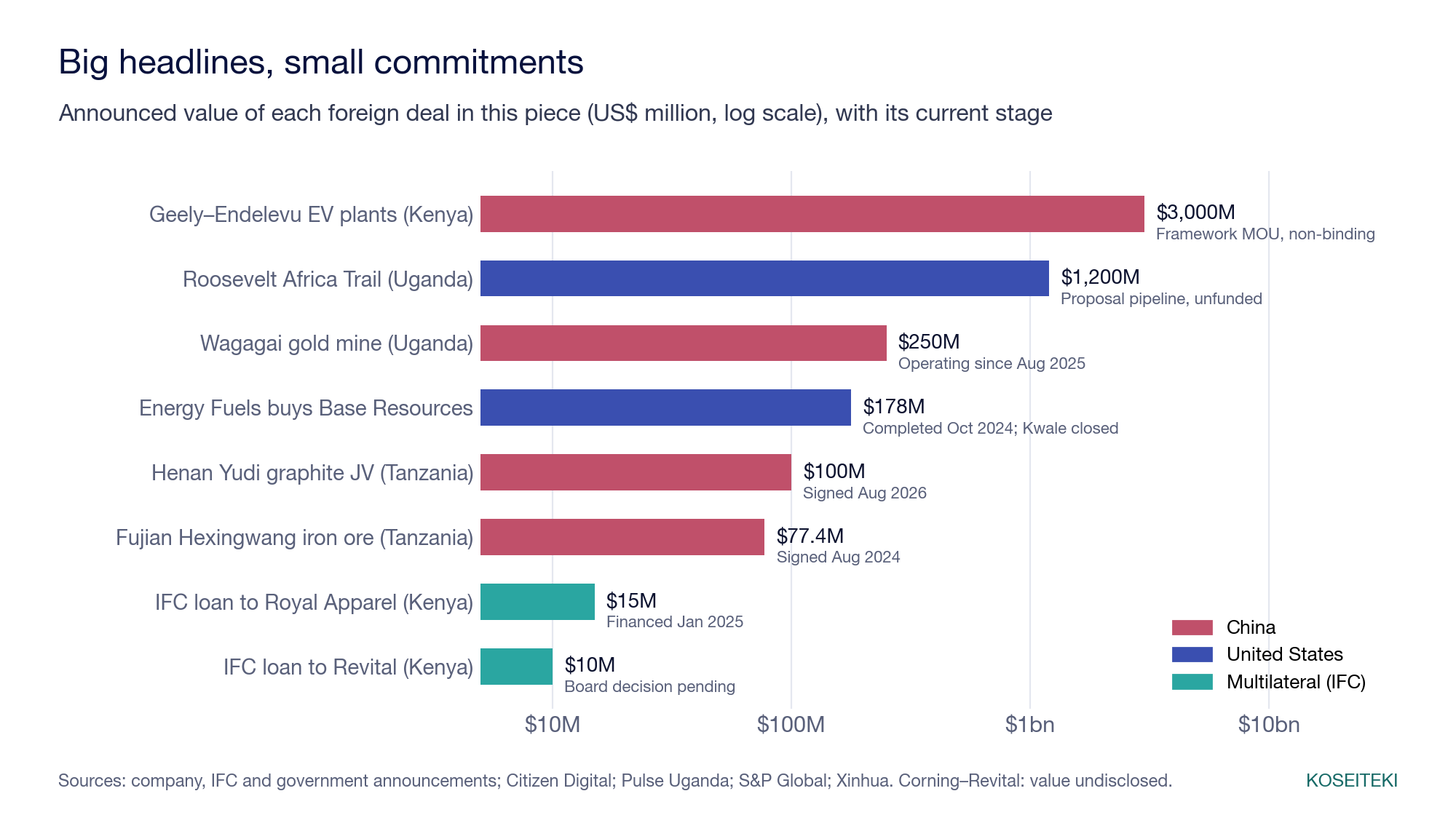
What to watch through 2027
- The Mrima Hill award. A named preferred bidder, and whether it is American, would be the first real test of Washington’s rare-earths interest in Kenya.
- IFC’s board decision on Revital (5 November 2026), and any capital figure from Corning that turns its letter of intent into an investment.
- The first zero-tariff trade data. Whether any processed or manufactured Kenyan goods reach China in volume before the arrangement’s April 2028 end date.
- Definitive agreements for Geely–Endelevu: site, financing and a groundbreaking date.
- Liganga–Mchuchuma signing. Whether the SDIG agreement is actually signed in the first half of FY2026/27, as promised.
- Roosevelt Africa Trail financing. Whether EXIM or the DFC approves any part of the $1.2 billion pipeline.
- Apparel unit values under AGOA. Whether the 2025 pattern of rising volumes and falling earnings continues now that access is secure to 2028.
The honest caveat
This piece draws on a mix of company and institutional press releases (Corning, August 2025; IFC, January 2025 and its October 2026 project disclosure for Revital), national statistics agency data reported through local business press (KNBS figures via Business Daily Africa and the Economic Surveys), US Trade Representative country data, trade and mining press for the Tanzanian joint ventures (S&P Global, The Guardian (Tanzania), Xinhua, Mysteel), Bank of Uganda monthly trade data via Monitor (Uganda) and Reuters, and US government and Ugandan press coverage of the Roosevelt Africa Trail announcement, spanning 2019 through late 2026. Several figures, Uganda’s and Tanzania’s export totals in particular, come from aggregated reporting rather than a single primary customs source and should be cross-checked against UNCTAD, World Bank or national central bank data before being treated as exact. Kenya’s 2025 zircon exports to China are reported only within a combined ores category, so the statement that the line has dried up rests on that proxy and on the Kwale closure. The semiconductor-export anomaly flagged under Kenya remains unverified.
A round of candidate partnerships was checked against available sourcing and set aside. A Corning–Nia Fiber fibre-optics MOU, a Twaweza–European brands deal, an $11 million Nexgen Packaging investment and a “current” $3 billion Sichuan Hongda Tanzania deal either could not be confirmed or turned out to be older agreements recirculated as new. None of the four is used here. The Roosevelt Africa Trail required a similar check: the announcement itself is real and well covered, but the $1.2 billion figure is an unfunded, unapproved pipeline of proposals rather than committed capital, and the project is tourism and coffee-branding infrastructure rather than the industrial trade corridor it can sound like at a glance.
Sources cited
- Corning Incorporated, “Corning and Revital Healthcare Sign Letter of Intention to Establish Joint Life Sciences Manufacturing Footprint in Africa,” 7 August 2025; Revital Healthcare, partnership announcement, 11 August 2025
- Medical Design & Development, “Corning, Revital to Establish Joint Life Sciences Manufacturing Footprint in Africa”
- IFC project disclosure portal, Revital Healthcare (EPZ) Ltd, disclosed October 2026; Business Daily Africa, “IFC lends Sh1.3 billion to Mombasa medical device firm”; The Star, “Revital Healthcare eyes Dongo Kundu SEZ in expansion plan” (February 2026)
- IFC press release, “IFC Partners with Kenya’s Royal Apparel EPZ Limited to Support Manufacturing, Jobs,” 27 January 2025
- Business Daily Africa, “Exports to China fall 9pc on Kwale titanium mine closure” (2024 data); “Collapsed exports widen Kenya-China trade gap” (2025 data); “Copper scrap single largest Kenya’s export to China” (KNBS data)
- USGS, Kenya minerals information and Mineral Commodity Summaries (zirconium); World Bank WITS, HS 261510 exports
- Energy Fuels Inc., completion of Base Resources acquisition, 2 October 2024; Mining Technology, “Energy Fuels finalises purchase of Base Resources for $178m”
- People Daily, “Kenya lists market requirements as China’s zero-tariff policy comes into effect”; The Star, “Big opportunity for Kenya’s exports as China’s zero-tariff offer kicks off” (May 2026); The EastAfrican on the 1 May start date
- The Star, “Trump signs AGOA extension, hands Kenya exporters lifeline to 2028” (September 2026); Office of the US Trade Representative, Kenya and Tanzania country pages
- Kenyan Wallstreet, “Kenya’s apparel exports to the US” and “Kenya’s textile factories export more but earn less” (KNBS Economic Survey data); AGOA.info
- Miningmx, “Kenya opens bidding for prized rare earths deposit” (March 2026); Critical Metals Corp, Mrima Hill tender announcements (July 2026); Rio Times on the September 2026 shortlist
- Citizen Digital, “Ruto presides over signing of Ksh.389 billion electric vehicle investment deal,” 6 October 2026; The Star; Ecofin Agency
- Monitor (Uganda), “Uganda’s export story is increasingly written in gold” (Bank of Uganda data); Reuters via CNBC Africa, “Uganda export earnings up 36% in August on higher gold receipts”; Rio Times on export destinations
- Eastleigh Voice and Global Finance on the Wagagai gold mine commissioning (August 2025)
- US Presidential Proclamation on AGOA eligibility, effective 1 January 2024 (Uganda)
- Pulse Uganda, “Uganda lands $1.2 billion investment in Roosevelt Africa Trail under US ‘Trade Over Aid’ plan,” 26 September 2026; SoftPower News and PML Daily, September 2026
- TanzaniaInvest and Business Insider Africa on Tanzania’s 2025 mineral and gold exports (Bank of Tanzania data); Tanzania Chamber of Minerals and Energy reporting
- The Guardian (Tanzania), “Tanzania signs 266bn/- graphite deal” (17 August 2026); S&P Global, “Tanzania eyes 50,000 mt/year graphite output under new $100m China deal – minister” (18 August 2026)
- Xinhua, “Tanzania, Chinese firm sign 77-mln-USD iron ore mining project” (August 2024); Mysteel and SteelOrbis; The Citizen/Mwananchi (September 2026)
- The Respondents and The Guardian (Tanzania) on Liganga–Mchuchuma negotiations (2025–2026)
Image credits
- A general view of Mombasa Port on Kenya’s Indian Ocean coast.jpg, MEAACT Kenya, Public domain, Wikimedia Commons
- Ilmenite sand.jpg, Mx. Granger, CC0, Wikimedia Commons
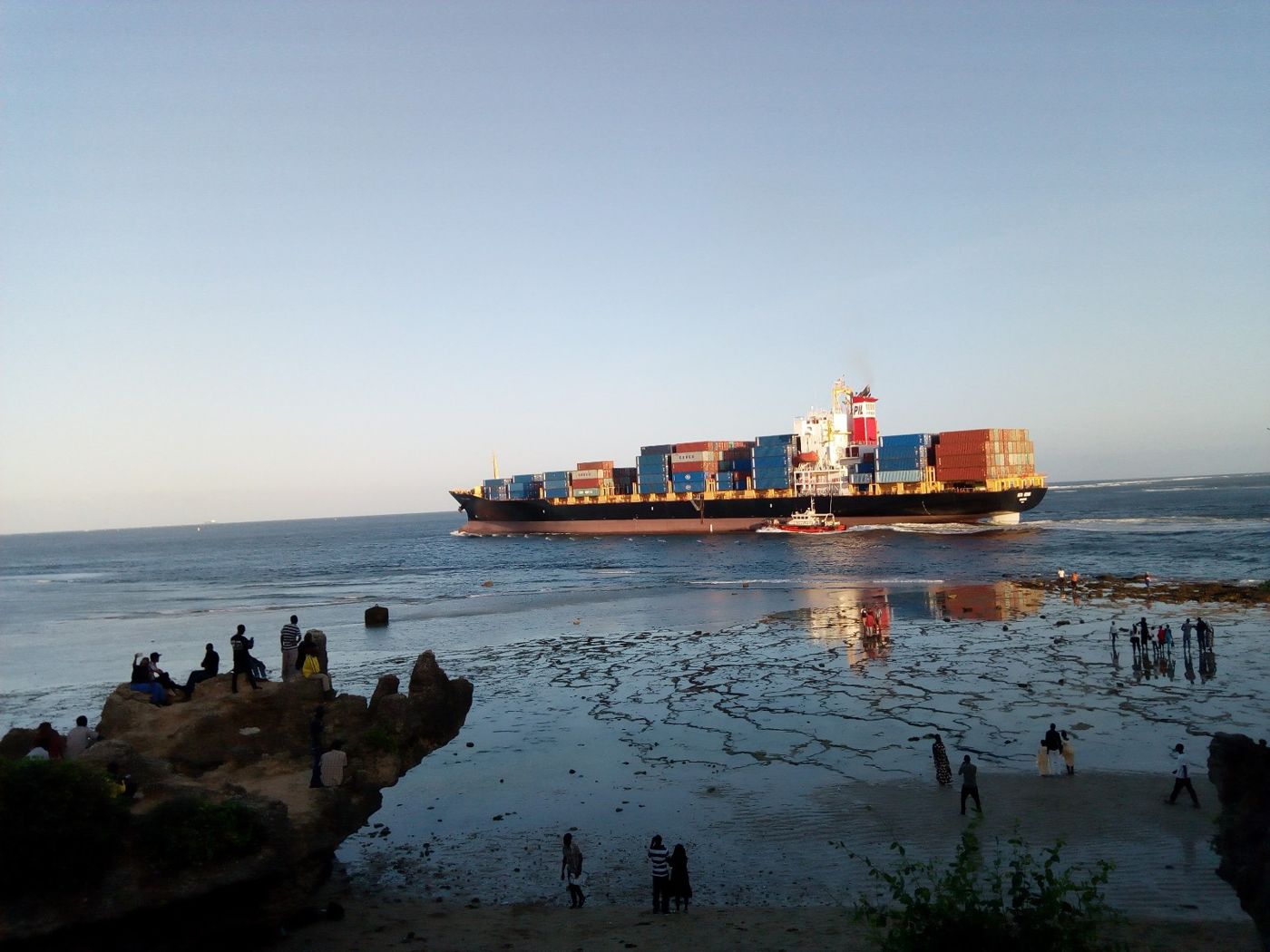
- Container ship exiting Mombasa port, Kenya 01.jpg, Ian Kiptoo, CC BY 4.0, Wikimedia Commons
- An artisanal gold miner from Eastern Uganda rests on a wheel barrow.jpg, Rukundo Joshua, CC BY-SA 4.0, Wikimedia Commons
- Flake graphite.png, 2x910, CC BY-SA 4.0, Wikimedia Commons
- Charts: Koseiteki, from the sources listed.
